

Elmore County
IDGenWeb


Please share your Family Group Sheet information, Descendents Chart, Photos, etc. of a Elmore County ancestor. Simply email your contribution to the County Coordinator.
ANDREWARTHA, Harriet H.
ARREGUI, Mateo
BATTAN, Roy L.
BAXTER, Charles F.
BECK, Albert W.
BRECKENRIDGE, John G.
BROADBENT, Harry M.
CASEY, Matthew
CAVANEY, Peter E.
EBY, Malanthen F.
FARADAY, Charles B.
HEDGES, Roy W.
HEWS, William U.
HOWELL, Adelaide
KIRBY, Daniel
McMILLAN, Thomas
MORROW, Annie
NEEDLES, Alonzo L.
NELSON, Charles A.
OSTNER, Edward C.
PARKIN, George
PASCOE, Charels E.
SARGENT, Mollie E.
SPANGENBERG, P. H.
STANTON, Willis C.
SWANN, Ester J.
THURMAN, Roland
ULMER, Thomas E.
ZEILOR, Joseph D.
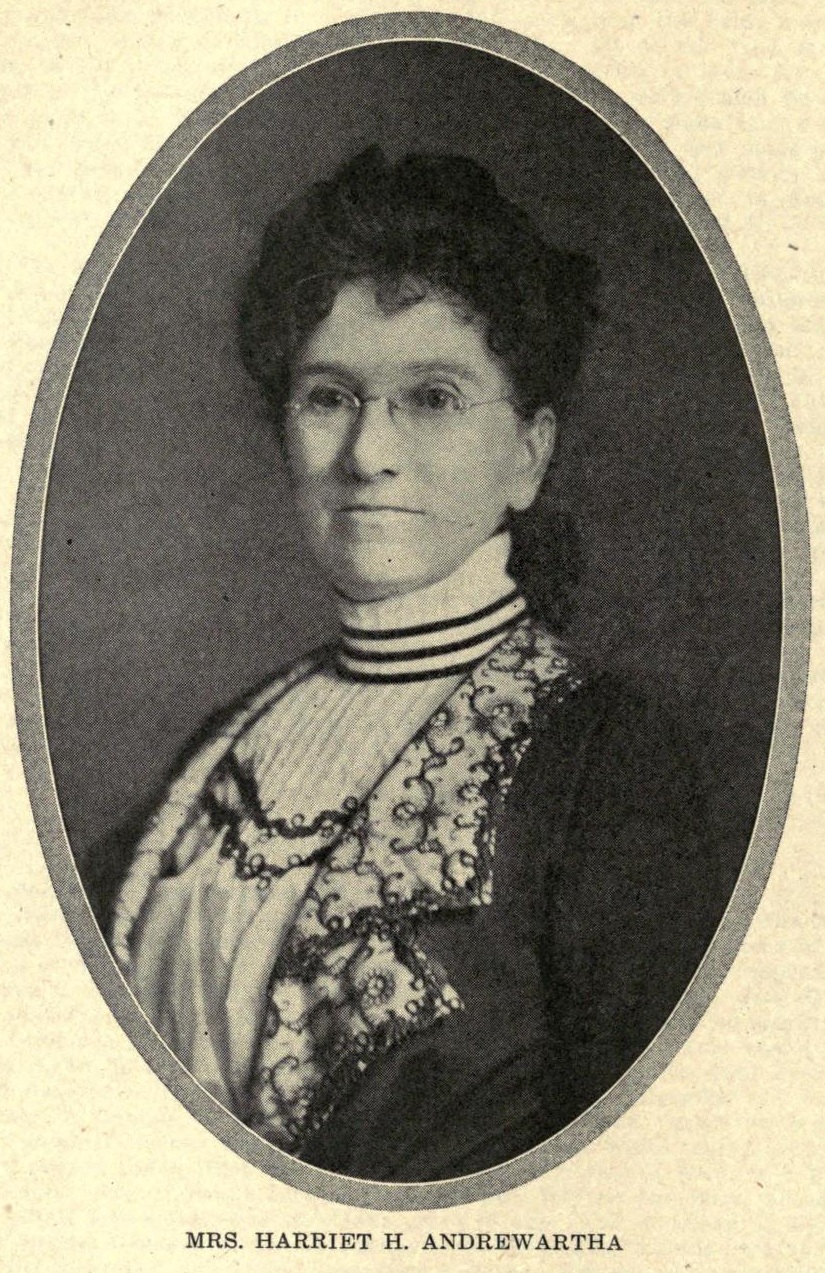 Mrs. Harriet H. Andrewartha occupies an attractive old home at No. 1111 Grove
street, in Boise, which she has occupied for the past third of a century. She is
numbered among the pioneer women of the state, having come to Idaho territory in
young womanhood as a school teacher from the state of Georgia in 1874. Her
maiden name was Harriet H. Dunagan and she was born in White county, Georgia,
July 31, 1849. She is a daughter of Frederick Dunagan, a musician of ability,
who also taught music and who became a prospector and miner, going to California
as a gold seeker in the early '50s. Later he came to Idaho, living in old
Alturas county for many years. He afterward removed to Baker, where he passed
away in 1907. His wife, who bore the maiden name of Louisa A. Kerbow, passed
away in Boise about twenty years ago.
Mrs. Harriet H. Andrewartha occupies an attractive old home at No. 1111 Grove
street, in Boise, which she has occupied for the past third of a century. She is
numbered among the pioneer women of the state, having come to Idaho territory in
young womanhood as a school teacher from the state of Georgia in 1874. Her
maiden name was Harriet H. Dunagan and she was born in White county, Georgia,
July 31, 1849. She is a daughter of Frederick Dunagan, a musician of ability,
who also taught music and who became a prospector and miner, going to California
as a gold seeker in the early '50s. Later he came to Idaho, living in old
Alturas county for many years. He afterward removed to Baker, where he passed
away in 1907. His wife, who bore the maiden name of Louisa A. Kerbow, passed
away in Boise about twenty years ago.
Their daughter Harriet was reared
upon a plantation in White county, Georgia, to the age of sixteen years, when
she became the wife of Benjamin West, of a fine old Georgia family. One child
was born of that marriage, William Lee West, whose birth occurred before his
mother was seventeen years of age. The marriage of Benjamin West and Harriet
Dunagan proved an unhappy one, the young husband turning out to be altogether
unworthy, and a legal separation followed. The son is now a resident of Idaho,
making his home in Boise county.
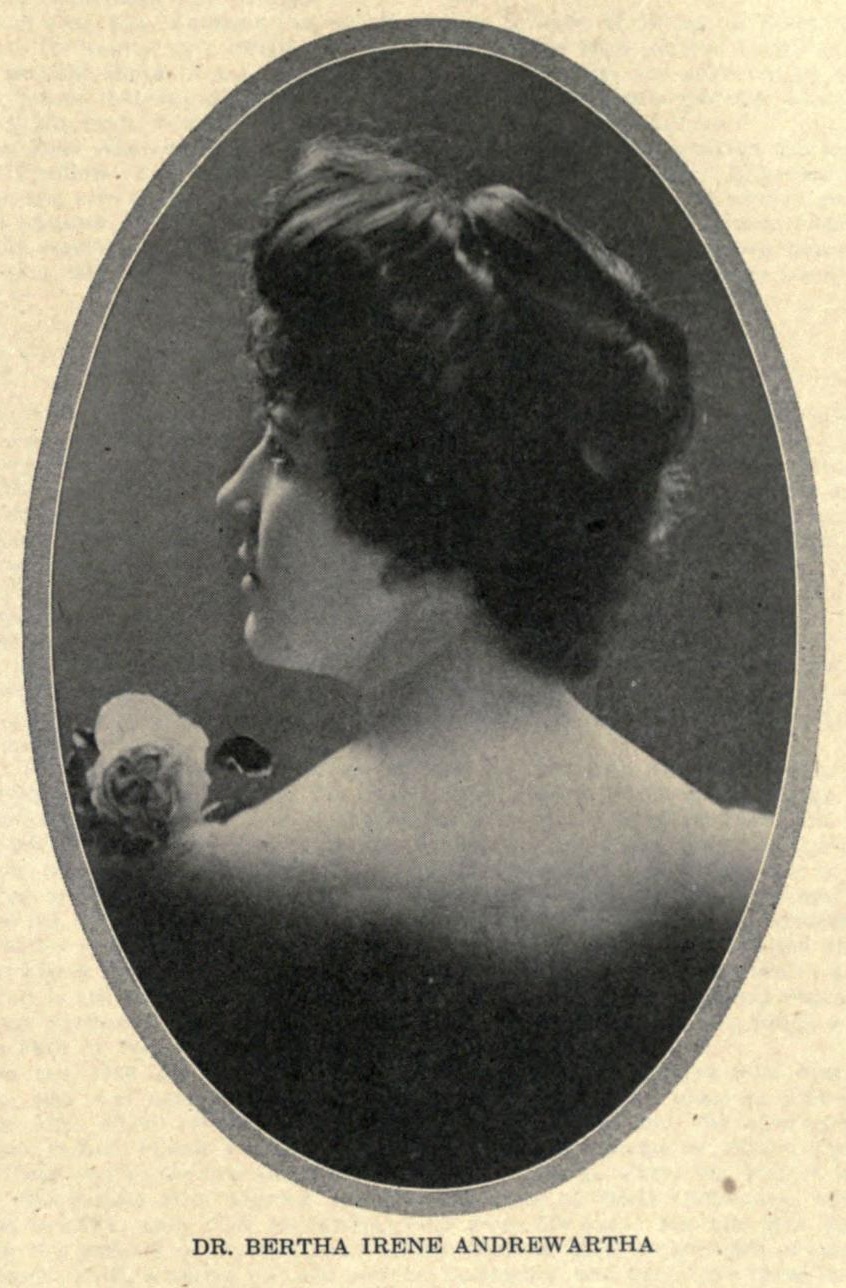 Mrs. Andrewartha was not quite twenty
years of age when she came to the territory of Idaho in 1874 to teach school,
bringing with her young son. She taught school for several years in old Alturas
county, now Elmore county, and for a considerable period resided on a ranch at
what is known as Mayfield before becoming a resident of Boise. In 1881 she was
married to the Rev. John Andrewartha in old Alturas county. He was a Methodist
minister and a man of splendid qualities and high standing. In 1885 a daughter
was born to them while they were still residing on Mrs. Andrewartha's ranch at
Mayfield, which she had homesteaded and which comprised one hundred and sixty
acres of land. Their daughter there born was named Bertha Irene and grew to
young womanhood, becoming a skilled physician. She was graduated from the
Willamette College of Oregon but became a victim of tuberculosis and passed away
when but twenty-four years of age.
Mrs. Andrewartha was not quite twenty
years of age when she came to the territory of Idaho in 1874 to teach school,
bringing with her young son. She taught school for several years in old Alturas
county, now Elmore county, and for a considerable period resided on a ranch at
what is known as Mayfield before becoming a resident of Boise. In 1881 she was
married to the Rev. John Andrewartha in old Alturas county. He was a Methodist
minister and a man of splendid qualities and high standing. In 1885 a daughter
was born to them while they were still residing on Mrs. Andrewartha's ranch at
Mayfield, which she had homesteaded and which comprised one hundred and sixty
acres of land. Their daughter there born was named Bertha Irene and grew to
young womanhood, becoming a skilled physician. She was graduated from the
Willamette College of Oregon but became a victim of tuberculosis and passed away
when but twenty-four years of age.
About 1889 Mrs. Andrewartha sold her
ranch to John McMillan, of Boise, and removed to the capital city, where she
purchased a large block of real estate on Grove street, between Eleventh and
Twelfth streets. This property she improved by erecting several houses thereon,
including three large, comfortable homes and five cottages, all of which she
rents to desirable tenants, thus enjoying a good income.
Rev. John
Andrewartha died seven years ago and Mrs. Andrewartha has since remained a
widow. She is a consistent member of the First Methodist Episcopal church of
Boise and also belongs to the Order of the Eastern Star. She is a woman
possessed of good business ability and of natural culture and refinement and is
most widely and favorably received in the best social circles of the city. In
fact her own home is the center of a cultured society and warm-hearted
hospitality is always there found.
Contributed 2025 Jul 18 by Norma Hass, extracted from 1920 History of Idaho: The Gem of the Mountains by James H. Hawley, Volume 3, Pages 200-205
Mateo Arregui, a wool grower and sheep man of Boise, who is a well known
member of the Basque colony of this city, was born in Spain, September 21, 1876,
the youngest in a family of eight children whose parents were Domingo and Maria
Ygnacia Ytuarte Arregui. The mother died when her son Mateo was but five years
of age and the father, who long survived, passed away in 1904, at which time
Mateo Arregui was in Spain, having returned to that country from the United
States, where he had already spent six years. The father was a farmer in Spain
and owned a small flock of sheep, numbering about twenty-five.
Mateo
Arregui was 'reared on his father's farm and at the age of nineteen years was
drafted into the Spanish army, Spain being at that time at war with the Cubans.
Mr. Arregui was sent with the Spanish army to Cuba under command of General
Weyler and spent fourteen months on the island — a year or so before the
Spanish-American war of 1898. From Cuba he returned to Spain in 1897, having
been granted the privilege of going home to assist in the care of his father,
who was then more than sixty years of age.
In 1899 Mr. Arregui came to
the United States, landing at New York city, and at once proceeded to Nevada,
where he spent three years in herding sheep and doing other ranch work,
receiving a wage of from fifteen to forty dollars per month. In 1902 he came to
Idaho and entered upon active connection with the sheep industry in this state
as a herder in Elmore county. In 1904 he returned to Spain to visit his father
and also for the purpose of marrying an old sweetheart of his boyhood. While the
son was in Spain, the father became ill of pneumonia and passed away.
It
was on the 14th of January, 1905, that Mr. Arregui wedded Miss Adriana Celaya
and at once they started for the United States with Idaho as their destination.
They soon established a home in Boise, where they have since lived. Mr. Arregui
has been identified with the sheep and wool industry throughout the intervening
period. While he came to Idaho as a herder, he carefully saved his earnings
until he was enabled to own sheep, and through the intervening years he has
prospered, carrying on the business of sheep and wool growing and conducting
business as a partner of Jose Arostegui under the firm name of Arregui &
Arostegui. They now have several thousand sheep grazing on the Idaho ranges.
Mr. and Mrs. Arregui are the parents of three living children: Juan, born
July 12, 1909; Carmen, whose birth occurred on the 30th of October, 1913; and
Rose, whose natal day was October 14, 1917. One other child, a son, the first
born, was accidentally killed by being thrown from a horse at the age of seven
years. This was Teodoro, who was born November 9, 1905, and died November 10,
1912. Both Mr. and Mrs. Arregui are Catholics in religious faith, having
membership in the Church of the Good Shepherd of Boise, and he belongs to the
Knights of Columbus. Ever ready to respond to the call of opportunity, Mr.
Arregui has worked his way steadily upward in business circles and has
contributed in no small measure to Idaho's reputation as a leading sheep raising
district.
Contributed 2025 Jul 18 by Norma Hass, extracted from 1920 History of Idaho: The Gem of the Mountains by James H. Hawley, Volume 3, Pages 275-276
Roy L. Battan, identified with the automobile trade as proprietor of the Lei
ha Motor Supply Company at Letha, Idaho, was born at Grove City, Illinois,
August 18, 1880, and is a son of John and Mary (Dickinson) Rattan, who were
natives of Ohio and of North Carolina respectively. The mother is now living in
Hastings, Nebraska, but the father passed away in 1911.
Roy L. Battan
spent his early life in Illinois and Nebraska and was twelve years of age when
his parents removed to the latter state, settling in Hastings. After mastering
the branches of learning taught in the public schools he entered the University
of Nebraska at Lincoln, from which he was graduated on the completion of a civil
engineering course in 1907. In the summer of that year he made his way westward
to Spokane, Washington, where he followed his profession for several years, also
working along the same line in Idaho. In April, 1915, he settled at Letha and
established the first lumberyard of the town, conducting it for a year. He
afterward disposed of the business to the Gem State Lumber Company, for whom he
acted as manager for three years. Retiring from the lumber business, he
established a garage, opening the first garage at Letha. The business has
developed rapidly and is now one of substantial and gratifying proportions. The
Motor Supply Company owns a good building, well equipped for handling all kinds
of repair work and doing all kinds of garage service, and he carries a good line
of automobile tires and accessories.
On the 4th of November, 1908, Mr.
Battan was married in New Plymouth, Idaho, to Miss Hattie Hinchcliff, who was
born in Rio, Illinois, May 17, 1882, a daughter of Winfield Scott Hinchcliff,
who resides at New Plymouth, and of Edna (Biggart) Hinchcliff, who passed away
March 18. 1887. Mrs. Battan was a successful teacher in Canyon, Elmore and
Blaine counties for five years prior to her marriage and is a lady of innate
culture and refinement. Mr. and Mrs. Battan have four children: Thelma Francis,
who was born February 6, 1912; Richard Winfield, born June 12, 1914; Edna Mary.
July 3, 1917; and John Charles, March 2, 1920.
Mr. Battan and his wife
are republicans in their political views, giving earnest support to the party
and its principles, and fraternally he is a Mason. Both are members of the
Baptist church, in which he is serving as a trustee and as superintendent of the
Sunday school. They own a fine bungalow, one of the prettiest homes in Letha,
built in 1916, and, moreover, it is the abode of warm-hearted and generous
hospitality, being the center of a cultured society circle.
Contributed 2025 Jul 18 by Norma Hass, extracted from 1920 History of Idaho: The Gem of the Mountains by James H. Hawley, Volume 3, Page 57
Charles F. Baxter, proprietor of the Baxter Foundry & Machine Works of Boise,
came to Idaho in 1874 from New Jersey. The early years of his residence in this
state were passed at Rocky Bar and at Atlanta, Elmore county, where he lived
until 1880. He came to the west with his parents, his father being the late
Captain James Baxter, who passed away in Boise on the 19th of May, 1904, v/hen
seventy-two years of age. He was born in England and when a young lad of six or
eight years came to the United States with his parents, Francis and Mary J.
(Gunn) Baxter. The family settled upon a farm in New Jersey on which now stands
one of the largest silk mills-in the east, the location being at Paterson, New
Jersey. Captain Baxter volunteered for active service in the Civil war as a
member of the Union army, becoming a second lieutenant of Company K of the
Serrell Engineers of New York. He was wounded at Fort Sumter, South Carolina,
and sent home to die, but fate willed otherwise and upon his recovery he
rejoined the same command and was promoted to the rank of captain in recognition
of his bravery. He then remained at the front until the close of hostilities. He
was married at Paterson, New Jersey, in 1854 to Miss Amanda Langwith, who
survives and makes her home in Boise. She was born in Paterson, New Jersey.
Captain and Mrs. Baxter became the parents of four children, three daughters and
a son.
The latter, Charles F. Baxter, who was the youngest of the family,
came to Idaho in 1874. His father was a mining and civil engineer and also a
machinist by trade, having served an apprenticeship as a machinist in Paterson,
New Jersey. From 1874 until 1882 he was manager for the Leonora Mining Company
and for the Big Lode Mining Company, both of old Alturas county. During the same
period he acted as consulting engineer and installed the machinery for the old
Monarch and Buffalo mining companies, all of Atlanta, Idaho. Previous to this Le
had been general manager of the Ophir Mining Company of Rocky Bar. From 1882
until 1889 he was in old Mexico in charge of the interests of the Guadaloupe
Mining & Development Company, a Philadelphia concern, his position being that of
managing director. In the latter year he returned to the United States and for a
year and a half was a resident of Newark, New Jersey, and then spent six months
in Chicago. On the expiration of that period- he removed to Baker City, Oregon,
and later to Candelaria, Nevada. He followed his profession of mining
engineering in connection with the White Star Mining Company but in 1891
returned to Idaho, making his home in Boise until his death. In 1892 he founded
the present Baxter Foundry & Machine Works, which he conducted for several years
under the name of James Baxter & Company, his only son, Charles F. Baxter, the
present owner, being associated with the father in the management and operation
of the foundry and succeeding to the entire control even before the father's
death. Later he changed the name to the Baxter Foundry & Machine Works. It is
the pioneer concern of t tic kind in Boise and the principal industry of its
line in the city. James Baxter and his wife celebrated their golden wedding
about a month before the former's death in 1904.
Charles F. Baxter was
born in Paterson, New Jersey, and was but eight years of age when his parents
first came to Idaho but returned to New Jersey with them in 1880. He served a
five years' apprenticeship to the trades of a machinist and boiler maker in
Newark, New Jersey, and afterward pursued a preparatory college course in New
York city, where he studied mining and mechanical engineering, assaying and
analytical chemistry. In 1888 he went to Chicago, working there in a machine
shop, in which he built some special machinery, and later he was sent by his
employers to Baker City, Oregon, where he erected a free gold milling quartz
mill for the White Star Mining Company. In 1890-1 he erected a similar plant for
the same company in Elmore county, Idaho, and in 1891 he came to Boise with his
father. In 1892-3, in conjunction with his father, he established the plant now
known as the Baxter Foundry & Machine Works and during the succeeding four years
he also conducted an assay office and chemical laboratory in Boise, while at the
same time he was assisting in the operation of the Baxter Foundry & Machine
Works and also acted as consulting engineer on various other mechanical
projects. Finally he took full charge of the Baxter foundry about 1900 and has
directed its operations since, keeping it in the front rank among similar
enterprises in the northwest.
On the 12th of August, 1887, in Newark, New
Jersey, Mr. Baxter was married to Miss Kittie Ellen Kain, who was born in that
city, a daughter of John D. and Catherine Kain, who came to the United States
from Ireland. They now have three children: James, who was in the military
service of the United States during the World war and is now associated with his
father and brother in the business, and who married Marjorie Lucy Whittle,
November 19, 1919; Caroline L., at home; and Charles F., Jr., who is also
associated with his father. He was married in Pendleton, Oregon, September 28,
1910, to Hazel Nolen, who died September 2. 1918, leaving a daughter, Virginia
Lee Baxter, born July 25, 1911, and he was married September 15, 1919, to
Blanche Aubertine Christensen.
Mr. Baxter is a member of the Benevolent
Protective Order of Elks and the Independent Order of Odd Fellows. While he is a
believer in republican principles, he does not hesitate to cast a ballot in
support of democratic candidates if he thinks them better qualified for the
offices they seek. In other words he works and votes for what, he believes to be
the best interests of community, commonwealth and country and is at all times a
loyal and public-spirited citizen, while as a business man he occupies a most
enviable place as the head of one of the important industries of the state. His
ability as a mining and consulting engineer is based upon broad scientific
training and wide experience.
Contributed 2025 Jul 18 by Norma Hass, extracted from 1920 History of Idaho: The Gem of the Mountains by James H. Hawley, Volume 2, Pages 743-744
Albert W. Beck is a well known live stock man and ranch owner of Boise, who
resides at No. 1101 Fort street, in a splendid home, which he built about twelve
years ago. He came to Idaho in 1878 from Kelton, Utah, where he had resided for
a year, and previous to that he had spent a year and a half in western Kansas.
He is a native, however, of Pennsylvania, his birth having occurred in Venango
county, that state, January 29, 1857. He was one of the four sons of William and
Mary (Siegel) Beck, both of whom were natives of Germany but were married after
emigrating to the United States. The father lost his life in the great Chicago
fire in 1871. The mother afterward married John Jackson, who passed away
subsequently in Pennsylvania. His widow afterward came to Idaho and died at
Mayfield, Elmore county, about thirty years ago. Albert W. Beck has two living
brothers, Edward and Charles, both younger than he and now residents of
California, although formerly they made their home in Idaho.
In 1876
Albert W. Beck left the Keystone state and made his way westward to Kansas,
being then a young man of nineteen years imbued with the laudable ambition of
making the most of his opportunities, to which end he sought the advantages of
the growing west In 1878 he removed from Kansas to Idaho and throughout the
intervening period, covering more than four decades, he has been identified with
the live stock interests of this state. He has bought and sold horses, cattle,
sheep and hogs but has confined his attention largely to the first three and at
times has conducted business most extensively. In former years he would often
have as many as fifteen thousand sheep at a time. Prospering as a sheep raiser,
he became one of the men of affluence in the state. However, he retired from
active business several years ago, owing to the fact that the government forest
preserve lands were closed to sheep. He therefore decided to put aside business
activities, feeling that he had given enough attention to sheep raising.
However, he has since managed his ranch, comprising five or six hundred acres in
Elmore county, and has also owned and managed the Pacific Hotel of Boise, which
property he purchased in 1895 and has since owned, leasing it throughout the
entire period.
On the 2d of October, 1889, Mr. Beck was married to Miss
Jennie L. Corder, the eldest daughter of the late James Obediah Corder, a well
known pioneer of Elmore county, who conducted a store and hotel at Mayfield for
forty-two years and afterward removed to Boise, where he passed away in 1908.
Mr. and Mrs. Beck became the parents of three children, a son and two daughters,
namely: Anna A., who is a teacher in the Boise public schools; James Obediah, a
young man of twenty-four, who was married September 13, 1916, to Miss Gladys
Wells, who was then a teacher, and they now occupy the Beck ranch, living there
with their little daughter, Caroline Jane Beck, who was born July 22, 1917. The
youngest child of Mr. and Mrs. Albert Beck, is Dorothy Beatrice, who was born
June 6, 1902, and is now a junior in the Boise high school. i
Mr. Beck is
a Knight Templar Mason and a Mystic Shriner, and his wife is connected with the
Eastern Star. He and his family are members of the First Presbyterian church and
are people of genuine worth, enjoying the high regard, confidence and goodwill
of all who know them. Starting out in the business world independently when a
youth of nineteen years, Albert W. Beck has made continuous progress along well
defined lines of industry, and his perseverance and diligence have brought to
him a most substantial and gratifying success. His record proves conclusively
that success and an honored name may be won simultaneously.
Contributed 2025 Jul 18 by Norma Hass, extracted from 1920 History of Idaho: The Gem of the Mountains by James H. Hawley, Volume 3, Pages 483-484
John G. Breckenridge, a farmer residing five miles southeast of Boise on what
is known as the Charles Rein farm of forty acres, dates his residence in Idaho
from 1874, when he came to this state from Washington county, Missouri, with his
parents, being then but six years of age. He was born on a farm in Washington
county, October 23, 1868, the only son and child of his parents, James Isaac and
Josephine (Tennyson) Breckenridge. The father died in 1878, when John G. was but
nine years of age. Later the mother became the wife of Charles Rein, who passed
away November 6, 1919, and she now resides at No. 1015 North Fifth street in
Boise. Mr. Rein was formerly engaged in the wood business in Boise and later he
and his wife resided on a ranch adjoining South Boise, known as the Gallaher
ranch, which he and his brother, Jacob Rein, purchased about twenty-five years
ago. Charles Rein also purchased the forty acre ranch on which his stepson and
only heir now resides. He improved the property and planted twelve acres to
winter apples, including Jonathans and Roman Beauties. It is now a fine place,
the trees having grown to great size, and everything about the place is
indicative of the progressive spirit of the former owner and the present
occupant. About ten years ago Mr. Rein and his wife removed to Boise into a
house which Mr. Breckenridge owned, and the latter at the same time took up his
abode upon the ranch, which he still conducts, cultivating the place as his «wn
and getting all the income therefrom, merely paying taxes thereon and keeping up
the property.
Mr. Breckenridge has resided in Boise and this section of
the state continuously for forty-five years and has been closely identified with
live stock raising and farming. He has also given much attention to
horticultural pursuits, especially since locating on the Charles Rein ranch. In
1919 his orchards produced five thousand boxes of apples. He is very industrious
and progressive in everything that he undertakes, and his labors have been
rewarded with substantial and gratifying results.
Mr. Breckenridge was
married March 22, 1899, in Boise, to Miss Anna Corder, a daughter of the late
James Obediah Corder, a pioneer of Elmore county and member of a well known
family of Mayfield. He spent his last years in Boise, however. Mr. Breckenridge
and his wife have four children: George H., nineteen years of age, has recently
returned home after nineteen months' service in the United States navy, being
connected with the transport service, crossing the Atlantic eight times. James
T., aged eighteen; Charles C., sixteen, and Anna Josephine, aged five, are the
other members of the family.
Mr. Breckenridge is an Odd Fellow and
Woodman of the World, and his political allegiance is given the republican
party. He belongs to the State Horticultural Society and thus keeps in touch
with every advancement made along the line of fruit raising. His religious faith
is indicated in his membership in the Presbyterian church of South Boise. He is
one of the trustees of the Holcomb school, located a quarter of a mile from his
home, and he is interested in everything that pertains to the material,
intellectual, social and moral progress of his community.
Contributed 2025 Jul 18 by Norma Hass, extracted from 1920 History of Idaho: The Gem of the Mountains by James H. Hawley, Volume 3, Pages 475-476
Harry M. Broadbent, principal of the high school at Burley, was born in
Waucoma, lowa, April 23, 1887, a son of William and Jennie (Berry) Broadbent. He
left Iowa in. company with his parents when but seven years of age, the family
home being established at Ordway, Colorado. There the father engaged in farming
and upon the home farm Harry M. Broadbent was reared to manhood, pursuing his
education in the public schools, while later he attended the high school at La
Junta, Colorado, completing a course there with the class of 1907, while
subsequently he was graduated from the Colorado State Teachers' College as a
member of the class of 1911. He has devoted his entire life to the profession of
teaching, and removing to Idaho, he became connected with the public schools of
Hammett, Elmore county, there remaining for a period of five years, and for two
years was superintendent of schools at Hollister, Idaho. In 1918 he came to
Burley as acting superintendent and continued to fill the position from the 1st
of March until the close of the school year. He is now the principal of the high
school of Burley and is doing excellent work in promoting the school system and
in introducing methods of practical value. His standards are high and he has the
faculty of inspiring teachers and pupils under him with much of his own zeal and
interest in the work.
In 1910 Mr. Broadbent was married to Miss Betty
Leeright, a native of Murphysboro, Illinois, and a daughter of George W. and
Cassia (Pyatt) Leeright. Her father was a farmer of Illinois but afterward
removed to Burley, Idaho, where he is engaged in the sign business. Mr. and Mrs.
Broadbent have one child, Edwyna.
Mr. Broadbent belongs to the Masonic
fraternity and to the Knights of Pythias. His political allegiance is given to
the democratic party, and his religious faith is that of the Methodist Episcopal
church.
Contributed 2025 Jul 18 by Norma Hass, extracted from 1920 History of Idaho: The Gem of the Mountains by James H. Hawley, Volume 2, Pages 146-147
Matthew Casey, a prominent pioneer rancher of the Ustick neighborhood, who
came to Idaho in 1887 and some six years later, in 1893, settled on his present
place, lying north of Ustick, which he developed out of sagebrush, is a native
of Clinton county, Illinois, having been born on a farm in that county on April
29, 1852. He is a son of Daniel and Sarah (Johnson) Casey, the former of whom
was a Southerner by birth, and the latter a native of Illinois, in which state
they were married. The father was three times married, Sarah Johnson being his
second wife. By his three marriages he became the father of sixteen children,
but the subject of this sketch and one half-brother are the only surviving
members of the family. As the name indicates, the Caseys are of Irish
extraction, the first of the family to come to this country arriving very many
years ago.
Amanda Hinshaw, who married Matthew Casey, was also a native
of Illinois, born in Marion county, July 15, 1855, a daughter of William and
Nancy (Nichols) Hinshaw. Mrs. Casey was reared in the same neighborhood in
Clinton county, Illinois, as her husband, and in school they were classmates,
attending school in an old log house. They were often pitted against each other
in spelling matches, and Mr. Casey modestly admits that his wife was the better
speller.
Following their marriage, which occurred June 13, 1872, Mr. and
Mrs. Casey continued to reside in Clinton county, Illinois, engaged in farming
until 1887, when they removed to Idaho, living first at Atlanta, Elmore county,
then a mining camp. They remained in that place for five years, during which
period Mr. Casey was a stationary engineer, mail carrier, etc., and then removed
to Mountain Home, where he spent some time at farming.
It was in 1893
that he bought his present ranch, consisting of one hundred and sixty acres,
then covered with sagebrush, and he immediately proceeded to clear and cultivate
the tract and presently he had the greater part of it in good shape. Mr. Casey
sold twenty acres of his place, which lay in the valley below, but retains one
hundred acres for his own use and the remaining forty acres is in the possession
of his son, William Casey, the one hundred and forty acres lying on a broad
stretch of level table land. The Casey ranch is well developed and is one of the
best-kept places in the Ustick neighborhood, every feature of which suggests
comfort, contentment and happiness. Here, Mr. and Mrs. Casey are enjoying the
fruits of the industry of their younger years, the active management of the
ranch and the labors that go with it resting mainly on the shoulders of the son,
William Casey, who is fully equal to the responsibilities. The raising of hay,
grain and other crops, as well as dairy farming, have been the chief features of
the Casey ranch, at the same time the orchards frequently adding much to the
annual income.
Mr. and Mrs. Casey became the parents of nine children, of
whom two sons and two daughters are deceased. The survivors are all sons, as
follows: William Henry, born November 30, 1873; Alvin C., May 1, 1883; Charles
O., November 27, 1886; Virgil M., November 11, 1891; and Marvin N., May 2, 1900.
All are married but the last named, who lives on the home place with his
parents. Two of the sons, Alvin and Charles, are in the service of Oakes &
Company, wholesale grocers of Boise, the former being manager of the company's
branch house at Twin Falls, Idaho.
In religious faith, the Casey family
are Methodists, holding membership in the McMillen Methodist Episcopal church,
which is located in their home neighborhood, and in the works of which they take
an earnest part, as they do in all community affairs intended to promote the
welfare of the people at large. They give their wholehearted support to the
democratic party and are consistent supporters of the political principles of
that party.
Contributed 2025 Jul 18 by Norma Hass, extracted from 1920 History of Idaho: The Gem of the Mountains by James H. Hawley, Volume 4, Pages 156-157
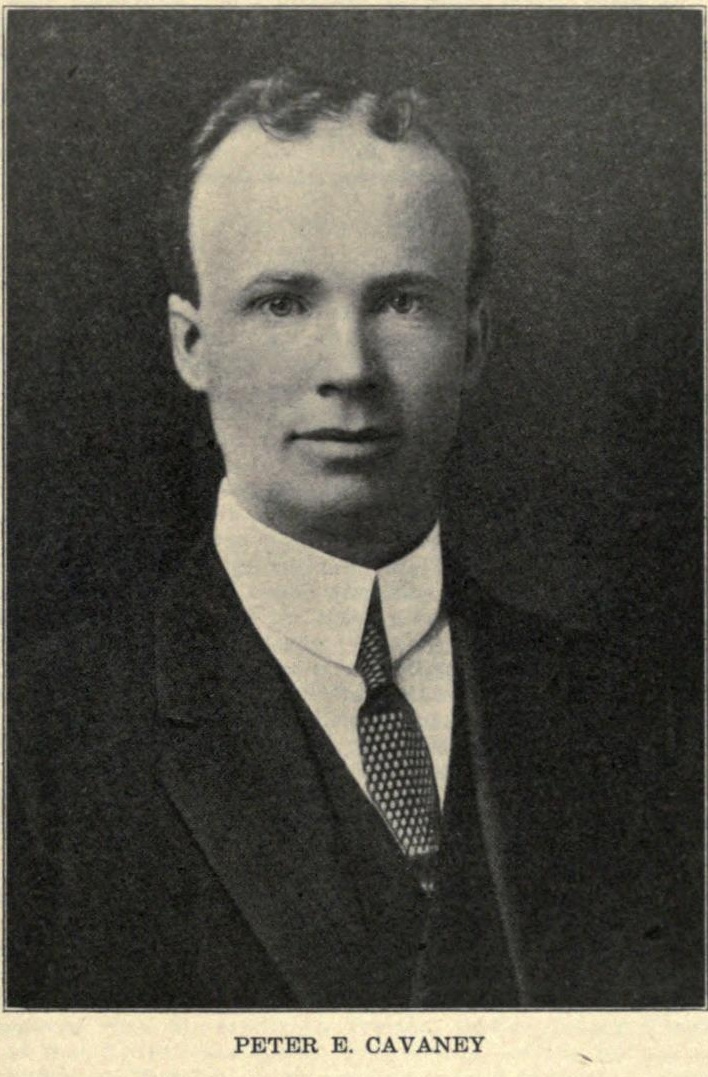 Peter Edward Cavaney, practicing at the Boise bar since 1907, was born in
Atlanta, Elmore county, Idaho, October 23, 1882. His parents, Michael and
Margaret (McGee) Cavaney, were natives of Canada and the state of New York
respectively and were of Irish and Scotch descent. The father came to Idaho in
1876 and devoted his attention to mining in connection with the development of
the Rocky Bar mining camp at Atlanta, Idaho, and the Black Jack mines at Silver
City, Owyhee county. While there he became associated with Colonel W. H. Dewey,
whom he afterward represented as superintendent of the Dewey properties in
Owyhee county. In 1890 he was injured in a mine explosion at Silver City and
there passed away in 1892, at the age of fifty-two years. His widow survives and
is yet a resident of Silver City. They were parents of nine children: Edmund C.,
a rancher and stock grower of Owyhee county; Edgar, who died in early life;
Michael C., a stockman of Kemmerer, Wyoming; Peter E.; James A., connected with
mining interests in Nevada; Margaret, who served for three terms as county
treasurer of Owyhee county; John, who died in Silver City at the age of eight
years; Frank A., a live stock raiser of Owyhee county; and William, who is now
deceased.
Peter Edward Cavaney, practicing at the Boise bar since 1907, was born in
Atlanta, Elmore county, Idaho, October 23, 1882. His parents, Michael and
Margaret (McGee) Cavaney, were natives of Canada and the state of New York
respectively and were of Irish and Scotch descent. The father came to Idaho in
1876 and devoted his attention to mining in connection with the development of
the Rocky Bar mining camp at Atlanta, Idaho, and the Black Jack mines at Silver
City, Owyhee county. While there he became associated with Colonel W. H. Dewey,
whom he afterward represented as superintendent of the Dewey properties in
Owyhee county. In 1890 he was injured in a mine explosion at Silver City and
there passed away in 1892, at the age of fifty-two years. His widow survives and
is yet a resident of Silver City. They were parents of nine children: Edmund C.,
a rancher and stock grower of Owyhee county; Edgar, who died in early life;
Michael C., a stockman of Kemmerer, Wyoming; Peter E.; James A., connected with
mining interests in Nevada; Margaret, who served for three terms as county
treasurer of Owyhee county; John, who died in Silver City at the age of eight
years; Frank A., a live stock raiser of Owyhee county; and William, who is now
deceased.
Peter E. Cavaney early attended the public schools of Silver
City, Idaho, and when seventeen years of age became a student in the Valparaiso
University of Indiana, where he won successively the degrees of Bachelor of
Arts, Bachelor of Science and Bachelor of Law. He has always been of a studious
nature and his reading has been broad along both scientific and literary lines.
Also a lover of the art of music, he developed his talents in that direction
under the teaching of Professor Louis G. Gottschalk, of Chicago, and Professor
Harold L. Butler, now of Syracuse, New York, completing his musical course by
graduation. It was through teaching mathematics, vocal music and other branches
that he earned the money necessary to continue his own education.
After
completing his law course Mr. Cavaney practiced in South Chicago for about six
months and then returned to Idaho, opening an office in Boise, where he has
since remained in active practice, having been admitted to the Idaho bar May 6,
1907. On the 15th of April, 1911, he was appointed city attorney of Boise and on
the 25th of October, 1912, received the appointment of assistant United States
attorney for the district of Idaho. He has won a creditable place in
professional circles and at the same time has cooperated in the establishment
and management of several successful business enterprises.
On the 10th of
November, 1909, Peter E. Cavaney was married to Miss Maude N Martin, a native of
Salubria, Idaho, and a daughter of the late R. H. Martin, Sr., who at the time
of his death in 1906 was a resident of Boise. Mr. and Mrs. Cavaney have three
sons, Edward M., born in Boise, October 9, 1912; Byron M., born in Boise. May
24, 1915; and William M., born April 11, 1918.
Fraternally Mr. Cavaney is
connected with the Woodmen of the World and the Benevolent Protective Order of
Elks, and politically is a stanch republican. In this he shows the independence
of his character, as he was reared in the democratic faith. While he has no
ambition for office, he has done considerable campaign work and party
organization. The major part of his attention, however, is concentrated upon his
law practice, which has constantly developed in volume and importance.
Contributed 2025 Jul 18 by Norma Hass, extracted from 1920 History of Idaho: The Gem of the Mountains by James H. Hawley, Volume 2, Pages 360-363
Malanthen F. Eby, a mining man of Boise, who became a pioneer resident of the
city and whose history is closely interwoven with Idaho's development, was born
in Canton, Ohio, January 1, 1852, his parents being Andrew Jackson and Sarah
Jane (Albright) Eby. The father died in Iowa many years ago but the mother now
resides on the Boise bench near the capital city at the advanced age of
eighty-seven years and is mentioned at length on another page of this work.
M. F. Eby was but an infant when his parents removed from Ohio to Iowa and.
upon a farm in the latter state he was reared to young manhood. While there
residing he engaged in the operation of a threshing machine, following the
threshing business for twenty-seven years, of which twenty-six years were passed
in Iowa and one in Montana. He started in the business as soon as he was old
enough to stand on one of the old-time horse power machines and hold the whip,
being a lad of but eight years when he took up work of that character. While
engaged in threshing he had his right hand caught in a belt and the injury
caused the loss of his index finger. He has always been a most industrious and
energetic man, never afraid of hard work, and his close application and
determination brought to him the substantial measure of success which he now
enjoys.
On the 4th of July, 1874, Mr. Eby was married to Miss Caroline
Reinig. They began their domestic life in Iowa but in 1879 removed to Montana,
where they lived until 1882, when they returned to Iowa. After three years, or
in 1885, they came to Idaho and Mr. Eby has since made his home in the Boise
valley, living chiefly in or near the city of Boise. In this state he has
followed ranching and mining pursuits and has owned various ranch properties in
Ada, Gem and Elmore counties. He still has ranch interests but for the past
eighteen years has given his attention largely to mining investments, which were
placed in Valley and Idaho counties.
To Mr. and Mrs. Eby have been born
six children: Frank M., mentioned elsewhere in this work; Mrs. Leota Pearl
Lambach, whose home Is near Boise; Mrs. Minnie Stella Shepherd; Daniel A.,
living at Kuna, Idaho; Mrs. Mabel Wood, of Boise; and Mrs. Elbia Eliza Grebe, of
Kuna.
In former years Mr. Eby took a most active interest in Idaho state
politics in the days when the populist party was prominent and he was the
candidate of that party for several high offices, including that of secretary of
state, state treasurer and county assessor. He was solicited to become a
candidate of the populist and democratic parties for the United States senate
but declined. Mr. Eby now has In his 'possession a most interesting photograph
of five generations, taken in January, 1920, and including Mrs. Sarah J. Eby,
now eighty-seven years of age, M. P. Eby, F. M. Eby, a grandson, Fred B. Eby,
and a great-granddaughter, Erma Eby, who was eighteen months old at the time the
picture was taken.
Contributed 2025 Jul 18 by Norma Hass, extracted from 1920 History of Idaho: The Gem of the Mountains by James H. Hawley, Volume 3, Pages 588-589
Hon. Charles B. Faraday is numbered among those men whom public franchise has
chosen to aid in framing the laws of the commonwealth as members of the state
senate. In this connection he is representing Elmore county, being a resident of
Mountain Home. He has lived in Idaho since 1891, removing to the west from
Harrisburg, Pennsylvania. He was born in Bradford county, that state, on the
20th of November, 1873, and was reared and educated in the east. When seventeen
years of age he came to Idaho to win a fortune if possible through the
opportunities afforded in the growing west. He has since lived in this state.
From 1891 until 1908 he resided in Owyhee county where he was engaged in sheep
and cattle raising and in merchandising. Since taking up his abode in Mountain
Home he has continued to engage in the sheep and cattle business and is still
the owner of a fine ranch in Owyhee county which returns to him a most
gratifying annual income.
In his political views Mr. Faraday has always
been a democrat and in 1909 he was elected to serve for a term in the Idaho
House of Representatives. In the fall of 1918 he was returned to public office
in an election to the position of state senator from Elmore county. At that
election he carried every precinct in the county but one. He is now giving
thoughtful and earnest consideration to all the important and vital questions
which come up for settlement and his support of any measure is an indication of
his firm belief in its value as a factor in good government in the state or in
safeguarding the interests of the commonwealth. He is a member of the Boise
Lodge of Elks and he turns for recreation to fishing, hunting and outdoor
sports. The hope of winning success by removal to the west has found fulfillment
during the years of his residence in Idaho.
Contributed 2025 Jul 18 by Norma Hass, extracted from 1920 History of Idaho: The Gem of the Mountains by James H. Hawley, Volume 4, Page 172
The free life of the farm, with its immense opportunities for making a
splendid living and bringing up a family in comfort and healthy surroundings,
has ever appealed to Roy W. Hedges, a well-to-do rancher, residing three miles
northeast of Meridian, Idaho. He was born in Jefferson county, Nebraska,
September 20, 1884, a son of Clement and Eliza (Barnes) Hedges, both of whom now
live at Long Beach, California. He is one of a family of eight children — five
sons and three daughters — born to his parents. He spent his early life up to
the age of seventeen in his native county, where he acquired an education in the
public schools and later entered a business college at Lincoln, Nebraska, from
which he emerged well equipped with all the essentials of business training,
which in later life proved of considerable advantage to him. In 1901 the family
came to Idaho and settled on a farm near Meridian, and Mr. Hedges has lived
either in or near that city, engaged in farming, ever since. He has made
considerable money during this period in the sale of ranches, three of which he
profitably disposed of, and is now the owner of a well kept and well improved
place of forty acres, northeast of that city, one-half of the farm being a prune
orchard. One of the recent ranch sales netted Mr. Hedges over five thousand
dollars, made in the disposal of a farm of eighty acres which was only a short
time in his possession.
On February 23, 1910, Mr. Hedges was united in
marriage to Miss Minnie Mabel Howard, a native of Idaho, born in Elmore county,
January 4, 1888, and a daughter of William F. and Clara (Heidrich) Howard, who
reside at Emmett, this state. Mr. and Mrs. Howard are old pioneers, having come
to Idaho in an early day before it was admitted to statehood, and they have
since been witnesses to and participants in the growth and development of one of
the most progressive of western states.
Mr. and Mrs. Hedges are the
parents of one daughter, Mildred Joyce Hedges, born April 20, 1915. They are
earnest members of the Christian church. Mr. Hedges is a democrat and is a
member of the Odd Fellow order, in the affairs of which he takes a warm
interest.
Contributed 2025 Jul 18 by Norma Hass, extracted from 1920 History of Idaho: The Gem of the Mountains by James H. Hawley, Volume 4, Page 356
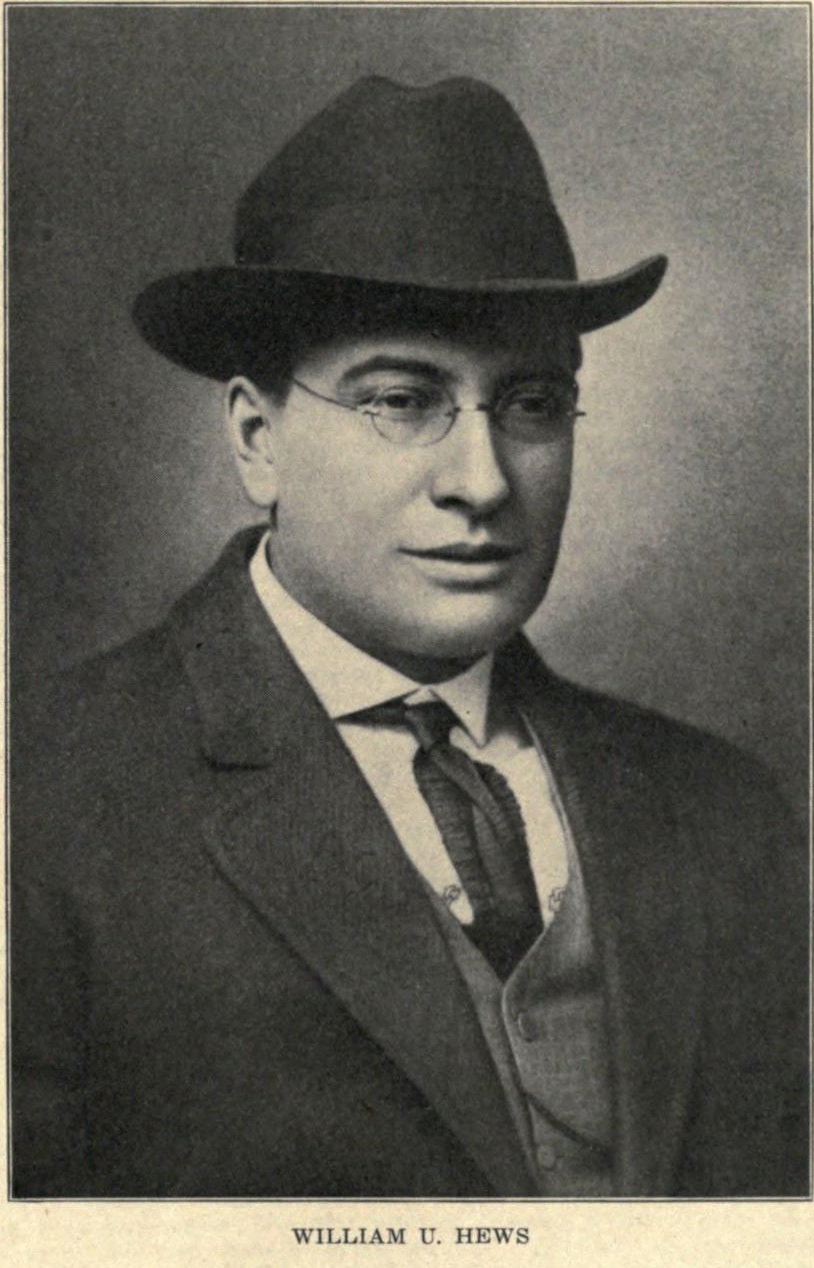 William
U. Hews, receiver of public moneys in the United States land office, Hailey,
Idaho, is a descendant of a long line of pioneers. Joseph Hews, one of the
signers of the Declaration of Independence, was a pioneer in North Carolina. Mr.
Hews' great-grandfather was a pioneer in New York; his grandfather was a pioneer
in Indiana; his father a pioneer in Iowa; and Mr. Hews, himself, a pioneer in
South Dakota when only seven years of age.
William
U. Hews, receiver of public moneys in the United States land office, Hailey,
Idaho, is a descendant of a long line of pioneers. Joseph Hews, one of the
signers of the Declaration of Independence, was a pioneer in North Carolina. Mr.
Hews' great-grandfather was a pioneer in New York; his grandfather was a pioneer
in Indiana; his father a pioneer in Iowa; and Mr. Hews, himself, a pioneer in
South Dakota when only seven years of age.
The father, Benjamin F. Hews,
served his country for four years as artilleryman in the great Civil war and was
engaged in many of the largest and most bloody battles in this gigantic struggle
which ultimately preserved the Union and guaranteed liberty to all its citizens.
Five years after the close of the war, he was united in marriage to Jane E.
Doolittle at Cresco, Iowa, where William U. Hews was born in November, 1872.
Seven years later the son removed with his grandparents, Mr. and Mrs. Uri
Doolittle, to Lake county, South Dakota, where the family settled on a
homestead, fourteen miles north of Madison. The country was new and the Indians
roamed over its prairies at will. Although they were friendly, they gave the
young pioneer many good scares. The settlers were never harmed by the natives in
that part of the state, although in the western part of South Dakota there were
many Indian outbreaks led by the notorious Sitting Bull. At that time there was
no railway at Madison and no schools and churches. Two years passed before these
evidences of civilization began to appear, but soon after this the country
gradually changed from the pioneer to a prosperous agricultural community.
In 1889 the grandfather removed to Madison for the purpose of giving
William, who was then a youth of seventeen, better educational advantages. The
boy had attended the country school only two years previous to this time, but
due to systematic home study he was able to enter the high school grades. After
he had attended the Madison schools for two years the grandfather died and
William was thrown upon his own resources. His first work was upon a dairy farm
with a meager wage of eighteen dollars per month and eighteen hours work each
day. One year of this strenuous labor was sufficient to teach the youth that
those who wish to use their minds in place of their muscles should aspire to a
liberal education, so he took the teachers' examination in order to use teaching
as a stepping stone in securing a better education. He taught one year in the
country schools and then secured employment in a newspaper office, where he laid
the foundation for general newspaper work. In 1894 he entered the State Normal
School of South Dakota, where he was graduated in the class of 1898. During his
entire course, he earned his living expenses by running the steam heating plant
in one of the dormitories of the institution. The work was heavy, but he
succeeded in securing high standings in the literary, oratorical and debating
lines. After graduation, he spent three years as principal of schools at Mt.
Vernon, Winfred and Blunt, South Dakota. During this time he used his spare
moments in reading law in order to obtain a general knowledge of the principles
as applied to business. After abandoning the teaching profession, on account of
the low salaries paid at that time, he went to Minneapolis, where he took a
special course in journalism and followed the work of reporter on city dailies
for some time previous to purchasing the Tri-County News at Irene, South Dakota,
in 1903. While publisher of this paper, Mr. Hews filled the offices of clerk,
assessor, and police judge. He also had county charge of the state capital
removal campaign fight in 1904. He made a good fight for Pierre and won through
an efficient county organization. Pierre carried the state by a large majority
and the capital removal problem was permanently settled.
In 1908 Mr. Hews
decided to move west, so he sold his newspaper business and came to Idaho,
locating at Filer, Twin Falls county. The town was then a little hamlet of less
than two hundred people. Three-fourths of the land was yet covered with
sagebrush. The country was untested in the agricultural line, but he had such
strong faith in the future prospects that he invested in two unimproved ranches
and established the Filer Films, which he sold a few months later. At the end of
a year he repurchased the printing plant and removed it to Buhl, where he
founded the Buhl Herald, which grew and developed with the country until it
became one of the best country weeklies in southern Idaho. In 1910 he sold the
Herald and went to Utah, where he spent several weeks looking over the state
with a view of locating there. After careful investigation, he decided to return
to Idaho, where he purchased the Glenns Ferry Gazette. During President Wilson's
first campaign Mr. Hews was secretary of the Elmore democratic county central
committee. He did very effective political work both as secretary of the
committee and as publisher. In 1914 he removed to Hailey, where he is now
serving his second term as receiver of public moneys in the United States land
office.
In May, 1915, Mr. Hews was united in marriage to Mrs. Jessie
Chapin, whose first husband, Charles Chapin, was assistant state engineer at the
time of his death in February, 1912. Mrs. Hews is the youngest daughter of J. E.
Harroun, of Albion, the first state superintendent of schools in Idaho.
Mr. Hews is a member of the Independent Order of Odd Fellows, the Fraternal
Order of Eagles and the Modern Woodmen of America. During the recent World war,
he took an active part in the Liberty Loan and other drives which civilians were
asked to conduct in order to make our army efficient at home and abroad. Since
coming to Idaho, Mr. Hews has done well socially, politically and financially.
He is well satisfied with the Gem state — the land of great resources and
opportunities. As an individual and as a publisher he has devoted his energies
to progress and improvement and has made his labors of worth to Idaho — the home
of his choice.
Contributed 2025 Jul 18 by Norma Hass, extracted from 1920 History of Idaho: The Gem of the Mountains by James H. Hawley, Volume 4, Pages 386-389
One of the best improved ranches in Ada county is the one hundred and sixty
acre place, located three miles northwest of Kuna, on which Mrs. Adelaide Howell
resides. She is the widow of William L. Howell, whose death occurred December
19, 1918, and since his demise she has continued to reside on the ranch. Her
only son, Donald S. Howell, who is married, resides on thts ranch with his
mother and supervises it.
Mrs. Howell was born in Allegany county, New
York, March 24, 1859, a daughter of Martin and Anna (Briggs) Lyon. She was
reared amidst beautiful home surroundings and on the 20th of April, 1880, was
united in marriage to William L. Howell, who was also a native of Allegany
county, he having been born on the 18th of February, 1858. While a resident of
New York state, Mr. Howell engaged in the manufacture of gloves and mittens at
Geneseo. In 1909 they decided to come to Idaho, and in this state they took a
one hundred and sixty acre relinquishment. This tract was all sagebrush, with
only a small shack on it. Mr. and Mrs. Howell determined to clear this land and
make it one of the best ranches in the county and, as a result of this
determination, they made excellent improvements, one of the most important being
a handsome and modern home. Good outbuildings were built and a family orchard
set out, which is now in full bearing. Mr. Howell was not long permitted to
enjoy his ranch, for he was called away from this life in 1918. His death came
as a sad blow to his family and his many friends. Not wishing to leave the home
which she and her husband had built with so many roseate plans for the future,
Mrs. Howell, with her only son, Donald S. Howell, continued to live on the
ranch, he taking charge of its management.
Mrs. Howell has three living
children, namely: Leona Pearl, Susan Maude, and Donald S. Leona Pearl is now the
wife of George Buckley of Hazelton, and Susan Maude is the wife of Herbert
McClintock of Wichita Falls, Texas. Donald S., the only son, was born April 9,
1887, and on December 9, 1916, was united in marriage to Miss Bessie Russell, a
native daughter of Idaho. She was born on Warm Springs Avenue, Boise, July 9,
1889, a daughter of the late William Russell, who died in Elmore county, Idaho,
November 5, 1905. He was a native of Illinois but came to Boise with his parents
when he was but five years of age. The grandfather of Mrs. Donald S. Howell,
George Russell, came to Idaho in 1861 and resided in Boise for many years, dying
there about twenty years ago. At one time he owned much valuable property in the
eastern part of Boise, and he built what is now the Lewis C. Merrill home in
Boise.
During his lifetime Mr. Howell was a member of the Masonic
fraternity and of the Presbyterian church. Mrs. Howell is a stanch supporter of
the Methodist church, and active in all affairs of that church. She is of fine
descent, being English on the paternal side and German-Bavarian on the maternal
side. She has been a loving mother and a fitting helpmate for her honored
husband. Her activity, ambition, general industry and diligence have won her the
esteem of all the people in her vicinity and she is enjoying the fruits of a
life of usefulness and unselfishness.
Contributed 2025 Jul 18 by Norma Hass, extracted from 1920 History of Idaho: The Gem of the Mountains by James H. Hawley, Volume 4, Page 483
Daniel Kirby, a mining man throughout his entire active life, identified with
the development of mining properties in Colorado. Arizona, New Mexico, the
republic of Mexico and Idaho, is now making his home in Atlanta, Idaho, and that
his interest in public affairs is more than personal is indicated by his
excellent service as representative from Elmore county in the state legislature.
Mr. Kirby was born In Pottsville. Pennsylvania, but all of his near
relatives live in Philadelphia. His parents were Bernard and Rosanne (Carbey)
Kirby, who were born, reared and married in the north of Ireland. Mr. Kirby
eventually determined to try his fortune in the United States and embarked for
the new world, being thirteen weeks on the Atlantic ere he reached the American
coast. After making preparations for a home he sent for his wife, who joined
him, and she. was nine weeks on the trip to the new world. The father devoted
his life to the occupation of coal mining and both he and his wife have now
passed away.
Daniel Kirby was reared and educated in Pennsylvania and in
his boyhood days, when not in school, worked in the coal mines, early beginning
to provide for his own support in that way. He left the Keystone state in 1876
and made his way westward to Illinois, while a year or two later he again
started westward, this time making Leadville, Colorado, his destination. There
he remained for several years, devoting his attention to mining and prospecting,
and in 1884 he took charge of a large mine at Lake City, Colorado, having three
hundred and fifty miners under his direction. In 1891 he became manager of an
extensive mine at Rico, Colorado, the property being largely owned by the
Standard Oil Company. There he occupied the very responsible position of manager
for three years, having seven hundred and fifty men in his charge. On the
expiration of that period, however, he returned to his former position at Lake
City. Colorado. In 1902 he came to Idaho, where he has since made his home, and
he has been the means of bringing much money into the state for investment in
mining properties. For the past twenty-three years he has been the western
representative of T. N. Barnsdall, a wealthy oil and gas capitalist of
Pittsburgh, Pennsylvania, caring for his mining properties in various western
states. He was instrumental in Mr. Barnsdall's investment of over a million
dollars in Idaho alone in the development of various mining properties. Besides
receiving a. splendid salary in compensation for his services Mr. Kirby was
given much stock in the various mines. He is now manager of the Atlanta Mines
Company, a Barnsdall project, and he still remains in charge of the Idaho
interests of the Barnsdall estate. Mr. Barnsdall having passed away two years
ago.
About 1890, in Denver, Colorado, Mr. Kirby was married to Miss
Carrie Gracey, a. native of Illinois, who died in St. Luke's Hospital in Boise
in 1912 as the result of a surgical operation. She left two daughters: Grace,
the wife of H. V. Donovan, of Boise; and Annie, the wife of Freeman C. Phippon,
of Gooding, Idaho. There are also two grandchildren, Caroline and Mary Dell
Donovan.
In politics Mr. Kirby has always been a democrat and in 1918 was
elected a member of the Idaho legislature. Up to that time he had always refused
to become a candidate for office, but be is proving himself an able working
member of the house of representatives. He has been quite active in fraternal
organizations, belonging to the Odd Fellows, Knights of Pythias and Elks. He is
a past grand of the Odd Fellows lodge and has the twenty-five year membership
badge in the organization accorded him by the sovereign grand lodge of the
United States. He has ever been most loyal to the teachings and purposes of the
order exemplifying its high principles in his daily life.
Contributed 2025 Jul 18 by Norma Hass, extracted from 1920 History of Idaho: The Gem of the Mountains by James H. Hawley, Volume 4, Pages 544-545
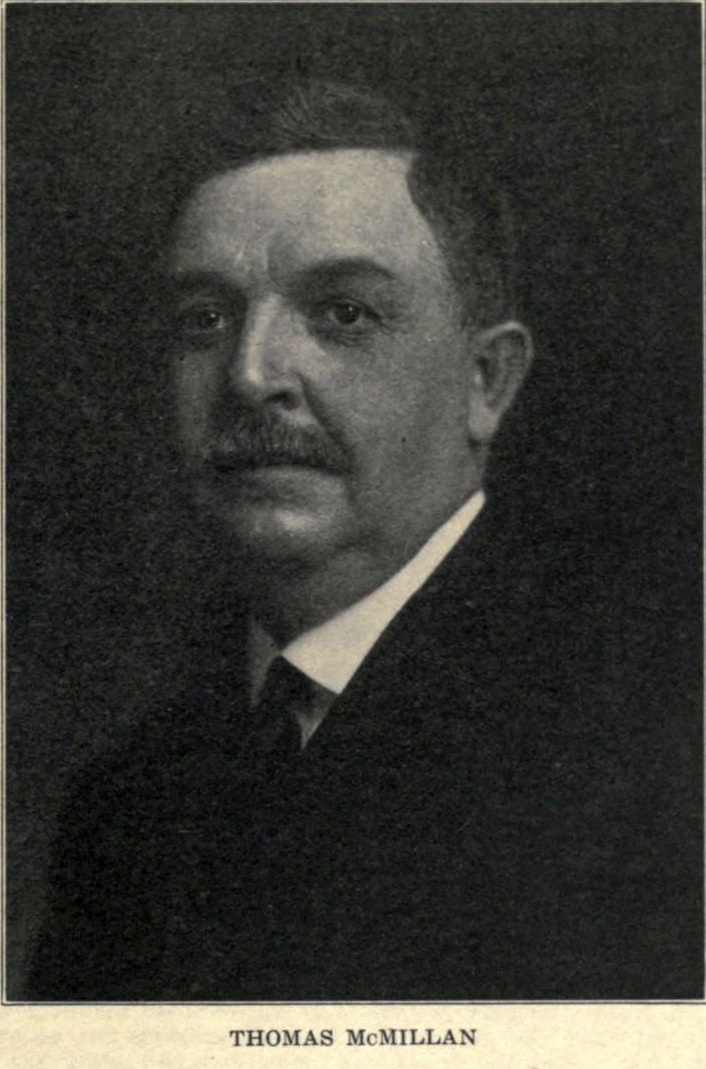 Thomas McMillan, well known in the business circles of Boise as the secretary
and treasurer of the Idanha Hotel Company and also as the secretary, treasurer
and general manager of the Boise Stone Company, controlling one of the important
industrial enterprises of the city, is of Scotch birth, a son of Anthony and
Agnes (McFadzen) McMillan, who in the year 1882 came with their family to the
new world. Thomas McMillan was at that time a youth of seventeen years, his
birth having occurred in Scotland, February 25, 1865. In 1881 an elder son, John
McMillan, now prominent in Boise, had crossed the Atlantic. The parents with
their other children landed in New York in 1882 and after a few years spent in
that state came to Idaho in 1886. They established their home in Elmore county
and subsequently removed to Boise, where both the father and mother passed away,
the former at the age of eighty-seven years, while the latter had reached the
age of seventy-eight. While in the land of hills and heather the father had
engaged in sheep raising. He was a representative of the well known McMillan
clan of that country.
Thomas McMillan, well known in the business circles of Boise as the secretary
and treasurer of the Idanha Hotel Company and also as the secretary, treasurer
and general manager of the Boise Stone Company, controlling one of the important
industrial enterprises of the city, is of Scotch birth, a son of Anthony and
Agnes (McFadzen) McMillan, who in the year 1882 came with their family to the
new world. Thomas McMillan was at that time a youth of seventeen years, his
birth having occurred in Scotland, February 25, 1865. In 1881 an elder son, John
McMillan, now prominent in Boise, had crossed the Atlantic. The parents with
their other children landed in New York in 1882 and after a few years spent in
that state came to Idaho in 1886. They established their home in Elmore county
and subsequently removed to Boise, where both the father and mother passed away,
the former at the age of eighty-seven years, while the latter had reached the
age of seventy-eight. While in the land of hills and heather the father had
engaged in sheep raising. He was a representative of the well known McMillan
clan of that country.
Spending his early youth in Scotland, Thomas
McMillan of this review secured a position as a clerk in the Bank of Scotland,
Glasgow, but when his parents came to the new world in 1882 he gave up his
position and accompanied them across the Atlantic. He did not tarry long in the
east but made his way westward to Wyoming, where he became a sheep herder. In
1886 he removed to Idaho and for a quarter of a century was one of the leading
sheep men of Boise, becoming president of the McMillan Sheep Company, in which
position he remained for many years. He was the founder of that company, which
prospered as time passed on, and he finally retired altogether from active
connection with the sheep industry in 1917. Indolence and idleness, however, are
utterly foreign to his nature and he could not be content without some business
interest. AJ; the present time, therefore, he is giving his attention to his
duties as secretary and treasurer of the Idanha Hotel Company of Boise and as
secretary, treasurer and general manager of the Boise Stone Company. The latter
is a big concern of its kind — one of the largest industrial enterprises of the
capital, with A. J. Swain as the president and Gus Carlson as vice president. In
1899 Mr. McMillan was one of the builders of the Idanha Hotel and has continued
as one of the owners, while for several years past he has been active in the
direction and control of the interests of the company. He is likewise a director
of the Boise City National Bank. His judgment is sound, his discrimination keen
and that his efforts have been wisely directed is indicated in the substantial
measure of prosperity which he has attained.
Mr. McMillan was married
March 16, 1897, to Miss Roxie Corder, who was born and reared in Elmore county,
Idaho, a daughter of Obediah Corder, one of the pioneers of that district. They
have become the parents of two daughters, Roxie and Irene, both graduates of the
Boise high school and now students in the University of California at Berkeley.
Mr. McMillan turns to hunting and fishing for recreation. In politics he is
a republican where national questions and issues are involved but at local
elections supports the candidates whom he regards as best qualified for office
without considering party ties. He belongs to the Benevolent Protective Order of
Elks. While there have been no spectacular phases in his life, neither have
there been any esoteric chapters, his career being that of an energetic business
man whose determination and perseverance have enabled him to overcome all
difficulties and obstacles in his path and work his way steadily upward to success.
Contributed 2025 Jul 18 by Norma Hass, extracted from 1920 History of Idaho: The Gem of the Mountains by James H. Hawley, Volume 2, Pages 426-429
Idaho has a long roster of tough pioneers, but one of the toughest was “Pegleg” Annie Morrow, of Elmore County (pop 29,130). One winter day in 1896 while she was walking across Bald Mountain with her friend Dutch Em, a fierce blizzard blew up. When a search party found the pair, Morrow was half frozen and her friend was dead. A doctor amputated Morrow’s frozen feet. Morrow later became a mother and successful businesswoman. She died in 1934 and was buried in Boise’s Morris Hill Cemetery.
Alonzo L. Needles is the proprietor of Shadow Lawn, a ranch pleasantly and
conveniently situated two miles south of Emmett and devoted to the raising of
grain and live stock. Mr. Needles came to Idaho in 1899 from the state of Kansas
and through the intervening years he has won the prosperity that makes him one
of the substantial agriculturists of Idaho today. The beautiful shade trees upon
the place give to it the name of Shadow Lawn.
Mr. Needles was born in
Kansas. September 16, 1871, and is a son of Ervin Minor and Mary Elizabeth
(Byerly) Needles. The father, who was a veteran of the Union army, has now
passed away, but the mother survives and is yet living in Kansas.
Alonzo
L. Needles was reared upon a farm in the Sunflower state with the usual
experiences of the farm-bred boy who divides his time between the duties of the
schoolroom, the pleasures of the playground and the work of the fields. Having
arrived at years of maturity, he was married at Independence, Kansas, on the 1st
of December, 1897, to Miss Katie Bradford, whose birth occurred in Rochester.
New York. January 20, 1878, and who is a daughter of Henry and Mary Ann
(Fitzmaurice) Bradford, who are all living, making their home near Independence.
Mr. and Mrs. Needles have become the parents of eleven children, of whom ten are
living. Mary Etta, who was born August 22, 1898, became the wife of Frank Hudson
on the 29th of August, 1917, and died of influenza on the 5th of February, 1919.
leaving a baby daughter named Billie Louise. The other children of the family
are: Freda Pearl, who was born August 27, 1899; Herbert Eugene, whose birth
occurred February 6, 1901; Treva Muriel, whose natal day was July 11, 1902;
Beulah Valeda, born January 11, 1904; Henry Lee. Born April 9, 1905; Alonzo
Glenn, born August 23, 1908; Coit Ernest, born November 3, 1911; Blanche
Loraine, born September 19, 1913; Clinton Ardell. born January 5, 1916; and
Wanda Roxena, who was born on the 30th of September, 1918.
Upon his
removal from Kansas to Idaho in 1899, Mr. Needles located on a forty-acre ranch
six miles northwest of Meridian, in Ada county. He purchased the property for
five hundred dollars, or twelve and a half dollars per acre, but small as the
purchase price was, he could pay only fifty dollars down upon the property, as
that was the sum total of his capital at the time. He at once began the arduous
task of developing and improving the place, built fences and did everything he
could to transform the tract into a productive farm. He lived thereon for twelve
years and then sold the place for five thousand eight hundred dollars. He next
purchased a half section of land in Long Valley, in Boise county, erected a
house upon that tract, but two years satisfied him that the seasons there were
too short. In 1914 he exchanged that property for his present ranch southeast of
Emmett, trading three hundred and twenty acres in Long Valley for a forty-acre
tract near Emmett, but the superior value of the forty more than balanced the
extra acreage of the former place. Mr. Needles afterward bought twenty acres
adjoining the forty-acre tract and thus had a valuable ranch of sixty acres,
unsurpassed in all the Emmett section of the state, where there are many fine
small ranches valued at from one hundred and fifty to three hundred dollars per
acre, while many still smaller tracts with excellent improvements are bringing
nearly a thousand dollars per acre. After a time Mr. Needles sold his
twenty-acre tract at a profit of nearly a thousand dollars, retaining possession
of the original forty acres. For this he has refused three hundred dollars per
acre. In 1918 he built upon it a modern eight-room bungalow, fully equipped with
electric lights and other conveniences. He has also built an extension to the
barn and he has made the Shadow Lawn ranch one of the beautiful and attractive
properties of this section of the state, constituting one of the most pleasing
features of the landscape. In 1918 Mr. Needles took a homestead of three hundred
and twenty-six acres in Elmore county, Idaho, upon which he is now proving up.
This requires him to spend seven months of each year upon the property and carry
on the work of development and improvement. The rest of the time he spends at
Shadow Lawn.
Mr. Needles is a member of the Independent Order of Odd
Fellows and also is a republican in his political views. He has had neither time
nor inclination for office, however, but has concentrated his efforts and
energies upon carefully conducted business affairs, which have brought
substantial results.
Contributed 2025 Jul 18 by Norma Hass, extracted from 1920 History of Idaho: The Gem of the Mountains by James H. Hawley, Volume 3, Pages 849-850
Charles A. Nelson, a carpenter by trade, now residing on the Boise Bench,
about two miles south of Boise, was born in Sweden on the 27th of August, 1875.
He came to the United States in 1901, when a young man of twenty-six years, at
which time he was already an expert carpenter and cabinet maker. His father was
the owner of a farm in Sweden and thereon Charles A. Nelson was reared to the
age of sixteen years, when he turned his attention to cabinetmaking. He had
already acquired a fondness for the use of tools while in the manual training
department of the schools of his native country and, developing his natural
skill and ingenuity in that direction, he became very proficient both in
cabinetmaking and in carpentering.
On the 1st of May, 1901, he sailed for
America on the Campania of the Cunard line, and on the same steamer was Miss
Anna Matilda Olson, his future wife, who had been a schoolmate of his in their
childhood days. They landed at New York and immediately afterward both started
west for Chicago, where Miss Olson had relatives. Mr. Nelson, however, did not
remain in Chicago but made his way at ones to Hailey, Idaho, where he arrived on
the 15th of May, 1901, just fourteen days after leaving Goteborg, Sweden. He
spent several months in Blaine county and Elmore county and filed on a homestead
in the latter county in 1901. In the same year he purchased an adjoining tract
of one hundred and sixty acres and with characteristic energy began the
development of his three hundred and twenty acre ranch, upon which he resided
for several years. In the meantime his former schoolmate. Miss Olson, had come
to Idaho from Chicago and on the 30th of September, 1903, they were married.
They took up their abode on the Elmore county ranch, near Hill City, and there
remained until the fall of 1917. when Mr. Nelson sold that property and
purchased ten acres of fine land on the Boise Bench, paying two hundred and ten
dollars per acre. Upon this place he has erected an attr.Mtive modern bungalow
at a cost of four thousand dollars, supplied with bath, with running water and
also equipped with a heating plant. Here he and his family are most pleasantly
located and he works at his trade of carpentering in Boise and vicinity.
Mr. and Mrs. Nelson have become parents of three Children: Emma, born June 30,
1904; Oscar, whose birth occurred October 3, 1908; and Arthur, whose natal day
was December 16, 1912. Mr. Nelson has never had occasion to regret his
determination to come to the new world, for the business opportunities which he
sought have yielded him a measure of success that is gratifying. Not only is he
the owner of his excellent place on the Boise bench but also has interests in
copper mines in Elmore county.
Contributed 2025 Jul 18 by Norma Hass, extracted from 1920 History of Idaho: The Gem of the Mountains by James H. Hawley, Volume 3, Pages 281-282
Edward C. Ostner, one of the well known young business men of Boise who for
the past ten years has had the sprinkling contract for the city, was born in
Bellevue, Elaine county, Idaho, February 13, 1885, and is the only child of Mr.
and Mrs. Albert W. Ostner, of this city, and a grandson of the late Charles
Ostner, whose name is inseperably linked with Idaho's history, for he was a
pioneer of the state and a man of marked artistic tastes and talents, who carved
the George Washington statue that is now seen on the capitol grounds.
Edward C. Ostner was but five years of age when his parents removed to Boise and
in 1903 he was graduated from the Boise high school. For the past ten years he
has had the contract for street sprinkling in Boise and previous to that he had
spent four years in the state land office during the administration of Governor
Gooding. His early education embraced a year's study in the Montana School of
Mines and it was his plan then to become a mining engineer, but his fondness for
horses and live stock overcame his desire and he entered into other lines of
activity. On the 1st of January, 1911, he and a partner, William Howell, of
Boise, under the firm style of Howell & Ostner, were given a five year contract
for street sprinkling in Boise. At the expiration of that period Mr. Ostner
purchased his partner's interest in the teams and equipment and took the
contract for another five years on his own account. He also has ranch and cattle
interests in Elmore county.
In November, 1918, Mr. Ostner was married to
Miss Fay Griffith, of Moscow, Idaho, and in Boise they have a wide acquaintance
among the best people. His chief recreation is polo and he is also fond of
hunting and fishing. Fraternally he is connected Avith the Benevolent Protective
Order of Elks.
Contributed 2025 Jul 18 by Norma Hass, extracted from 1920 History of Idaho: The Gem of the Mountains by James H. Hawley, Volume 2, Page 850
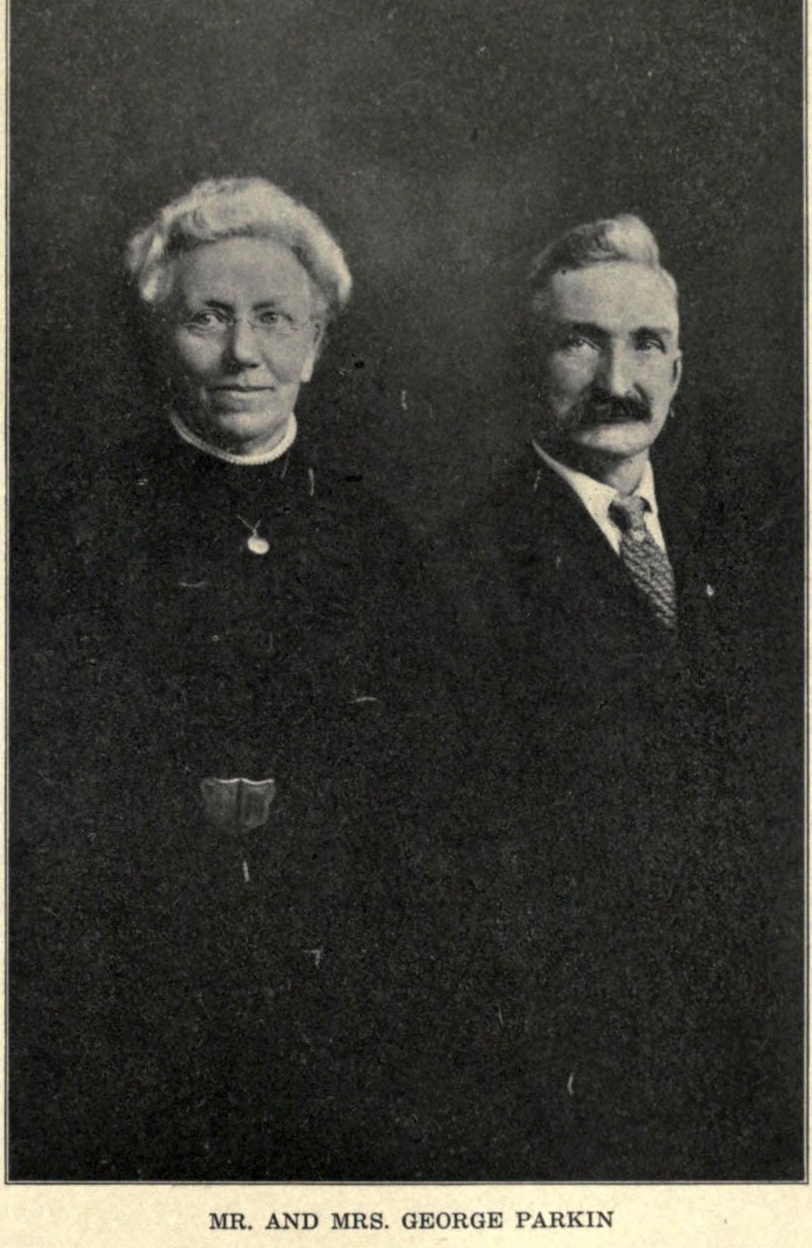 The life record of George Parkin is the story of successful and honorable
achievement, and he is now numbered among the men of affluence living at
Meridian, having put aside the active work of the farm to enjoy in well earned
rest the fruits of his former labor. Not all days in his career have been
equally bright. He met untold difficulties and hardships in early pioneer times
in gaining a start, but resolution and determination have enabled him to
overcome these and as the years have passed his labors have brought to him
substantial prosperity.
The life record of George Parkin is the story of successful and honorable
achievement, and he is now numbered among the men of affluence living at
Meridian, having put aside the active work of the farm to enjoy in well earned
rest the fruits of his former labor. Not all days in his career have been
equally bright. He met untold difficulties and hardships in early pioneer times
in gaining a start, but resolution and determination have enabled him to
overcome these and as the years have passed his labors have brought to him
substantial prosperity.
Mr. Parkin was born in Durham county, England,
February 4, 1852, but is yet young in spirit, keenly interested in everything
that pertains to Idaho and her welfare. He is a son of Matthew and Matilda
(Wygate) Parkin, who spent most of their lives in England. The father was a
machinist by trade and, leaving his native country, went to Egypt, where he was
employed for seventeen years as head machinist under the khedive. Later,
however, he returned to England, where he continued to make his home until
called to his final rest.
George Parkin had but limited educational
opportunities, for when only seven years of age he began working in the coal
mines, being thus employed until he reached the age of nineteen. He was
afterward employed at different kinds of work and for a time was in Egypt with
his father, but homesickness caused him to return to England. Later he was
married, Miss Sarah Wilkinson, a daughter of Robert and Mary Wilkinson, becoming
his wife in 1879. Her forefathers for two hundred years had lived on the same
estate in England. Mrs. Parkin was the youngest of ten children and was well
trained in household affairs, so that she became a most able assistant and
helpmate to her husband. On the 5th of December, 1879, they sailed for America
on the steamer City of Berlin, which was the first steamship equipped with
electric lights that crossed the Atlantic ocean. On landing in New York city
they proceeded to Scranton, Pennsylvania, and after a few months there passed
continued their journey to the northwest, first settling at Butte, Montana. Mr.
Parkin was employed in hauling cordwood in that state, where he remained until
May, 1881, and then drove with team and wagon to Boise, where he arrived in the
month of August. For a period he was engaged in trading between Boise and
Atlanta and after thus working for a time as a freighter he secured a homestead
of one hundred and sixty acres near Meridian, in Ada county, located along the
line of what became known as the Settlers ditch. At the time of his arrival,
however, the country was dry and there was no water to irrigate the land, so
that he found it difficult to gain a start. He supplemented the income derived
from what little he could raise in dry farming by killing Jack rabbits, upon
which a bounty had been placed by the state and local governments as the rabbits
were a menace to everything raised in the district. He eagerly welcomed the
proposition of digging the Settlers ditch and was one of the first men in 'the
locality to begin work thereof. The venture, however, was not successful for
some years and in the meantime Mr. Parkin pursued the work of the farm, building
a house upon the land which he homesteaded and bending every energy to the
development of his place. There was, however, little market for farm products,
as all of the settlers were attempting to raise crops, finding that lack of
water was their greatest obstacle. John Lemp had undertaken to put in a ditch,
or rather finish the old ditch which the settlers had started. These settlers
insisted that the name of Settlers ditch should be retained and were not very
enthusiastic supporters of the Lemp enterprise. «Aft«-r a time they got a supply
of water from the Ridenbaugh canal and when Lemp finished his undertaking there
was a plentiful supply of water all through the country. Farming and kindred
activities then received an added impetus and wealth began to flow into the
district.
With the development of his farm Mr. Parkin established a dairy
and for twenty-five years was actively and successfully engaged in that
business. About 1908 he sold his farm for twenty thousand dollars and his stock
for twelve thousand dollars. Throughout the entire period in which he carried on
dairying he never failed to take butter to town each Saturday save on one
occasion in 1901, when there was a terrific blizzard. His wife, too, was of the
greatest assistance to him and many times she drove into town with the products
of their dairy. She ably managed the household affairs and did everything in her
power to assist in gaining a start in the new country. After disposing of his
dairy interests Mr. Parkin devoted his attention to the management of a large
ranch of six hundred and forty acres on Camas prairie, in Elmore county, where
he raised fine horses and cattle. He established an attractive home in Meridian
and became the president of the Meridian Building & Loan Association, also a
stockholder and director in the First National Bank of Meridian and a
stockholder in the Meridian Spray Manufacturing Company, which engaged not only
in the manufacture of the material for spraying fruit trees but also in the
manufacture of cider and vinegar. Thus as the years passed Mr. Parkin became a
most active business man, connected with many lines that have contributed
directly to the upbuilding and progress of the section in which he has long
lived.
In 1914 Mr. Parkin was called upon to mourn the loss of his wife,
who passed away on the 20th of March of that year. Her sterling worth and many
excellent traits of character were recognized by all who knew her. She was not
only a capable and resourceful woman in the management of her household affairs,
but possessed a kindly nature and genial disposition that endeared her to all
with whom she came in contact. For thirty-nine years Mr. Parkin has now resided
in Idaho, spending the entire period in Ada county, and there is no phase of its
development and progress with which he is not thoroughly familiar. Year by year
he has made steady advancement, owing to his close application and indefatigable
industry, and his life history indicates clearly what can be accomplished
through individual effort. Today he is one of the prosperous residents of
Meridian, his constantly increasing business interests bringing to him a most
substantial measure of prosperity, and, moreover, his wealth has been so
honorably won and so wisely used that the most envious cannot grudge him his
success.
Contributed 2025 Jul 18 by Norma Hass, extracted from 1920 History of Idaho: The Gem of the Mountains by James H. Hawley, Volume 2, Pages 738-741
Charles Edward Pascoe, editor of the Owyhee Nugget, published at Bruneau, was
born in Ohio, March 21, 1862, and is a son of Charles and Charlotte (Roland)
Pascoe. They came to Ohio in 1862 and both spent their remaining days in that
state. They reared a family of four children, all of whom are yet living.
Charles Edward Pascoe, the youngest member of this household, was reared and
educated in Ohio, pursuing his studies in a private academy. The opportunities
of the west attracted him, however, and in 1887 he made his way to Montana,
where he lived for two years. On the expiration of that period he went to
Seattle, where he was engaged in the newspaper business for two years, when in
1890 he removed to Payette, Idaho, and there established the Payette
Independent, which he conducted for two years. At the end of that time he
disposed of his paper and went to Salt Lake City, Utah, where he was employed on
the Tribune for a time. In 1894 he removed to Ogden, Utah, and worked on the
Ogden Standard for some time, after which he became a resident of Brigham, Utah,
and was engaged in the newspaper business there for a period of five years. In
1902 Mr. Pascoe again came to Idaho, settling this time at Mountain Home, and
purchased the Elmore County Bulletin, which he owned and published for four
years. In 1916 he came to Bruneau, where he purchased the Owyhee Nugget and is
still owner and editor of this journal. He has always displayed a most
progressive spirit in his newspaper work and has kept in touch with modern
methods of journalism, publishing now a most interesting country sheet.
In 1892 Mr. Pascoe was united in marriage to Miss Caroline Engstrom, who was
born in Salt Lake City, Utah, a daughter of J. P. and Charlotte Engstrom, who
are still living. To Mr. and Mrs. Pascoe have been born four children: Charles
E., who is now in Dallas, Texas; Harold H.; Helen C.; and Roland E. The parents
are members of the Congregational church and are interested in all those forces
which make for moral progress and the uplift of the individual. Mr. Pascoe gives
his political endorsement to the democratic party and in 1917 was appointed to
the office of United States commissioner, in which capacity he is still serving.
Whatever success he has achieved in life is attributable entirely to his own
labors. Industry, perseverance and close application have been among his salient
characteristics and by reason of these qualities he has made for himself a
substantial position in newspaper circles in his adopted state.
Contributed 2025 Jul 18 by Norma Hass, extracted from 1920 History of Idaho: The Gem of the Mountains by James H. Hawley, Volume 4, Page 237
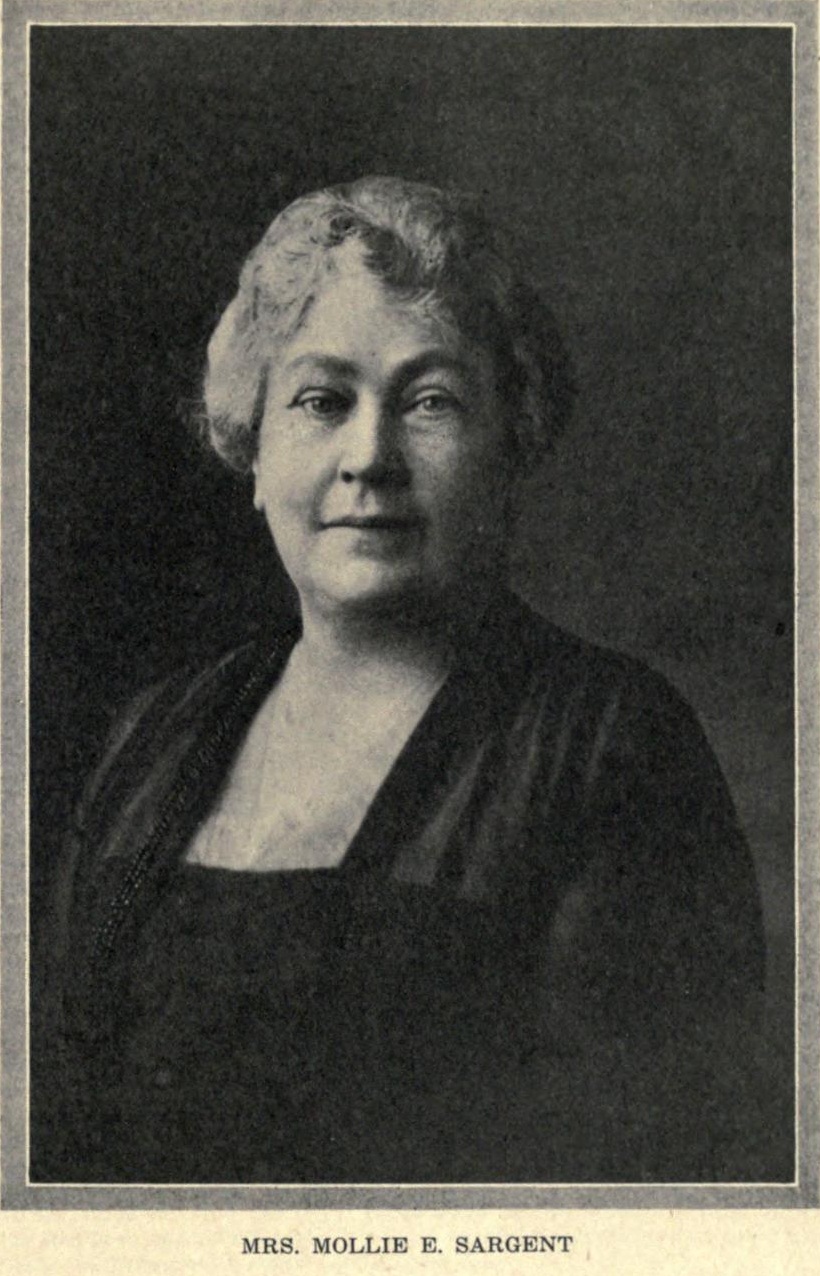 Mrs. Mollie Emily Sargent, one of the well known pioneer women of South
Boise, who resides in a beautiful residence of the rustic cobblestone style at
the corner of Broadway and Woodbine avenue, was born in Oregon but has spent
nearly her entire life in Idaho. She is a daughter of the late William M.
Stockton and his wife, who bore the maiden name of Nancy Farris, and both her
father and mother died at the home of Mrs. Sargent in South Boise in recent
years, the mother passing away August 24, 1916, while the father survived only
until April 1, 1917. He was eighty-one years of age at the time of his death,
while his wife had reached the age of seventy-six years. William M. Stockton and
Nancy Farris were married in the state of Iowa early in the '60s and about the
close of the Civil war they made the journey across the plains with a large
wagon train, numbering more than one hundred men, many with their families. Mr.
Stockton acted as captain of this train, which crossed Idaho and went on into
Oregon. Mr. Stockton and his wife located just over the line in Oregon, near
Lewiston, Idaho, and when their daughter Mollie was a little child they removed
with their family to Idaho and spent a few years at Boise, Mrs. Sargent
acquiring her early schooling in the capital city. When she was twelve years of
age her parents removed to Nevada but after four years returned to Idaho. At a
later period the Stockton family lived at Silver City for a time and also at
Weiser.
Mrs. Mollie Emily Sargent, one of the well known pioneer women of South
Boise, who resides in a beautiful residence of the rustic cobblestone style at
the corner of Broadway and Woodbine avenue, was born in Oregon but has spent
nearly her entire life in Idaho. She is a daughter of the late William M.
Stockton and his wife, who bore the maiden name of Nancy Farris, and both her
father and mother died at the home of Mrs. Sargent in South Boise in recent
years, the mother passing away August 24, 1916, while the father survived only
until April 1, 1917. He was eighty-one years of age at the time of his death,
while his wife had reached the age of seventy-six years. William M. Stockton and
Nancy Farris were married in the state of Iowa early in the '60s and about the
close of the Civil war they made the journey across the plains with a large
wagon train, numbering more than one hundred men, many with their families. Mr.
Stockton acted as captain of this train, which crossed Idaho and went on into
Oregon. Mr. Stockton and his wife located just over the line in Oregon, near
Lewiston, Idaho, and when their daughter Mollie was a little child they removed
with their family to Idaho and spent a few years at Boise, Mrs. Sargent
acquiring her early schooling in the capital city. When she was twelve years of
age her parents removed to Nevada but after four years returned to Idaho. At a
later period the Stockton family lived at Silver City for a time and also at
Weiser.
While there residing Mollie Stockton was first married and by
that marriage has two sons, Reginald W. Leonard and W. Vernon Leonard, both of
whom are graduate mining engineers, constituting the Leonard Engineering Company
of Boise, doing mining engineering and assaying. Reginald Leonard saw fourteen
months' service in France as a member of the Twenty-seventh United States
Engineers.
It was after the marriage of their daughter Mollie that Mr.
and Mrs. Stockton removed to the present site of Glenns Ferry, Idaho, thirty-one
years ago. Her father preempted land on which Glenns Ferry is built, securing
one hundred and sixty acres. He laid out the town and there he and his wife
resided until they had reached the evening of life, when they came to Boise to
spend their last days in the home of their daughter.
For five years Mrs.
Sargent was postmistress of Glenns Ferry, under appointment of President
Roosevelt and afterward of President Taft. By her second marriage she became the
mother of two daughters: Mrs. Freda Adams, now of Pocatello, Idaho; and Mrs.
Nance Laurene Farley, living at Prairie, Elmore county, Idaho. The former is the
wife of Len Adams and the latter of Allen C. Farley. Mr. and Mrs. Adams have one
son, James McEwen, born June 14, 1919, and Mr. and Mrs. Farley have a son, Keith
Cleveland, born July 19, 1917. These two grandchildren are the delight of Mrs.
Sargent.
Keenly interested in community affairs, Mrs. Sargent is a member
of the South Side Improvement Club of Boise. She belongs to the Episcopal church
and she also has membership with the Daughters of Rebekah, the ladies' auxiliary
of the Odd Fellows. Her political allegiance is given to the republican party.
Her home in South Boise is one of the beautiful suburban residences of the
state. It is built of cobblestones in a most artistic design and stands in the
midst of three acres of ground, beautifully laid out in lawns and adorned with
shrubbery, flowers and gardens and also supplied with much fruit.
Mrs.
Sargent has every reason to be proud of an old colonial ancestry, for she is a
descendant in direct line of Richard K. Stockton, who was one of the signers of
the Declaration of Independence. The family has always been noted for loyalty
and devotion to country and the same quality was manifest in her son, who joined
the army for service in the World war. She has one brother, Charles W. Stockton,
who is a prominent lawyer of New York city and is the vice president of the
Wells Fargo Express Company. He and Mrs. Sargent are the only survivors of the
family of William Stockton. From pioneer times Mrs. Sargent has now made her
home in the northwest and has been an interested witness of the changes that
have occurred and the transformation that has been wrought. She has prospered by
reason of judicious investments and is now the owner of a large amount of realty
at Glenns Ferry, including over one hundred improved lots, constituting a part
of the old Stockton homestead there. Her memory forms a connecting link between
the primitive past and the progressive present, and her stories of the early
days are most interesting and instructive. As the years have passed she has
reared a family who are indeed a credit to her, both sons and daughters having
made for themselves an enviable position and name.
Contributed 2025 Jul 18 by Norma Hass, extracted from 1920 History of Idaho: The Gem of the Mountains by James H. Hawley, Volume 2, Pages 118-121
P. H. Spangenberg, city building inspector of Boise and an electrician by
profession, has occupied his present position since 1914, with the exception of
about six months, which he spent as secretary of the district draft board. He
has made his home in Boise since 1910 and has been a resident of Idaho since
1906, removing to this state from Chicago to take advantage of the opportunities
created by the Cary act. He therefore purchased a ranch in Elmore county, on the
King Hill project, and developed it but later came to the capital.
Mr.
Spangenberg is a native of Watertown, Wisconsin. He was born April 25, 1881, of
the marriage of Mr. and Mrs. .George Spangenberg, the former a merchant tailor
and a veteran of the Civil war. The son was reared and educated in his native
town and upon leaving school went to Chicago, where he took up electrical work,
which he followed for many years in that city, in Pittsburgh and jn various
other places in the east. He has been identified with electrical work also
during the greater part of his residence in Idaho and formerly conducted an
electrical establishment at Mountain Home. His venture in the King Hill
Extension project in Elmore county proved to be a disappointment owing to the
enormous cost of the water for irrigation purposes. While the land could be
obtained practically free, he had to enter into a contract to pay an enormous
water rental and a brief experience was sufficient to convince him that such an
investment would not pay. Since 1910 he has lived continuously in Boise and in
1914 was appointed building inspector, in which capacity he has since rendered
valuable service save for the period of his connection with the draft board,
covering six months. He is prominent in labor circles and has been secretary of
the Idaho State Federation of Labor since it was organized in 1915 but lately
resigned the position.
Mr. Spangenberg was married in Chicago in 1906. He
is a thirty-second degree Mason and Mystic Shriner. He is also connected with
the Benevolent Protective Order of Elks and the Knights of Pythias, and his wife
has membership with the Pythian Sisters. Mr. Spangenberg is likewise identified
with the Sons of Veterans and in 1919 was commander of Phil Seridan Camp, No. 2.
He has served as a member of the Ada County Council of Defense and is interested
in all that is of substantial worth to the citizen and to the community at
large. As a public official he has ever been loyal and true to the trusts
reposed in him, and his record has been marked by devotion to the public
welfare.
Contributed 2025 Jul 18 by Norma Hass, extracted from 1920 History of Idaho: The Gem of the Mountains by James H. Hawley, Volume 2, Pages 548-549
Willis Clarence Stanton, who has spent the greater part of his life in the
neighborhood of Meridian, Idaho, now living four miles west of that city, is the
son of pioneer parents who came to Idaho in the early '60s, the father from
Kansas and the mother from Iowa. Mr. Stanton was born in what is now Elmore
county, Idaho, twenty-four miles east of Boise, near Mayfleld, November 20.
1874, a son of Frank and Nellie (Slater) Stanton. The father, who now resides in
south Boise, has to his credit the distinction of being one of the early
pioneers of Idaho, having crossed the plains in 1864 from Fort Leavenworth,
Kansas, where he had previously been in the service of the Union army, employed
as a teamster during the first years of the Civil war. Nellie Slater, whom Mr.
Stanton subsequently married and who is still living, came to this state with
her parents from Iowa in 1862. Shortly after coming west, the Slater family
removed to Oregon but later returned to Idaho and located in Boise valley. At
one time they lived at Centerville, where they kept the village tavern — in
those days a kind of clearing house for all local and district gossip and where
the weary and thirsty found rest and refreshment. Later on, the family located
on Slater creek, Elmore county, the creek being named in their honor.
Willis C. Stanton was reared on his father's farm on Indian creek, Elmore
county, and secured his education in the district schools. He has resided in
Idaho all of his life and has lived in the vicinity of Meridian for the past
thirty-five years, or since he was a boy of about ten years. In early life. Mr.
Stanton followed the somewhat hazardous and perhaps romantic career of a cowboy
for a few years, later being engaged at different pursuits. He was a ditch rider
on the Ridenbaugh ditch for eight years.
On November 11, 1903, at
Meridian, Mr. Stanton was united in marriage to Miss Fay Remington, a native of
Nebraska, born in Seward county, that state, November 15, 1883. and a daughter
of D. D. and Florence (Morgan) Remington, both of whom passed away in recent
years, the mother dying in Nebraska. Mrs. Stanton accompanied her father to
Idaho in 1902, first locating in Boise. Mr. and Mrs. Stanton are the parents of
five children: Clarence, born April 18, 1905; Cleona, August 1, 1907; Qracia,
April 11. 1909; Ethel, October 14, 1916; and Edna, January 20, 1919.
Mr.
Stanton gives his support to the republican party, while his wife espouses the
policies of the democrats. He is a member of the Independent Order of Odd
Fellows and both are affiliated with the Rebekahs. Mr. Stanton has shown
throughout many years of his active life, a close interest in all educational
affairs and has been a consistent supporter of all movements calculated to
advance the cause of education among the masses. He is now serving on the board
of directors of the Roosevelt school in his neighborhood and at the present time
is president of the board.
Contributed 2025 Jul 18 by Norma Hass, extracted from 1920 History of Idaho: The Gem of the Mountains by James H. Hawley, Volume 4, Pages 418-419
Miss Esther J. Swann is one of the successful business women of Nampa, at
present holding the position of treasurer of the Nampa and Meridian irrigation
district, in which position important duties fall to her lot. Her father, P. M.
Swann, is a native of Sweden and is at present in the employ of the United
States government in connection with road work at Grimes Pass, Idaho. In the
days of hda youth he was a great traveler and has twice rounded the globe. For
the past thirty years he has been a resident of Idaho, in which state he has
made many friends. His wife, a native of Marquette, Michigan, was In her
maidenhood Jennie Delia Erickson and at the age of four years was taken by her
parents to Colorado, where she received her education. In 1889 the family
removed to Rocky Bar, Idaho. Mr. and Mrs. Swann are the parents of two children,
Esther J. and Eric George, the brother and mother making their home with our
subject.
Miss Swann was born at Rocky Bar, Elmore county, Idaho, and
received her early education in the graded schools of her native county, after
which she attended high school for three years. In 1913 she went to Boise and in
order to better prepare herself for a business career took a course at Link's
Business College. Being thus well armed for life's duties, she set out upon her
independent career and became a stenographer for the Nampa and Meridian
irrigation district. It was but a year before she was promoted to the position
of assistant secretary and so rapidly did her talents develop that in
appreciation of her industry, faithfulness and trustworthiness she was made
treasurer of the district in April, 1918. She now has charge of all the
collections, which amount to upwards of four thousand from that many water
users. This in itself not only requires correct and quick work but also tact and
managerial ability. Miss Swann has all these qualities and, moreover, is a woman
of winning personality, who has many friends in Nampa.
Contributed 2025 Jul 18 by Norma Hass, extracted from 1920 History of Idaho: The Gem of the Mountains by James H. Hawley, Volume 2, Page 611
Roland Thurman, whose connection with Boise dates from pioneer times, was
born in the parental home that stood on the site of the Baptist church on Tenth
street, his natal day being November 19, 1870. His father, W. L. Thurman, came
to Idaho from the south in the early '60s and settled at Soda Springs, after
which he removed to Boise, while subsequently he took up his abode at the place
known as the old Thurman Grist Mills on the Boise river, about eight miles west
of the capital city. There he operated his mill and was the owner of most of the
land adjacent thereto. He also owned the Bill Francis place on Eagle Island, now
the property of Truman C. Catlin. His possessions aggregated about eleven
hundred acres in these two places. After living at the mill for about twenty
years he sold the property and removed to a stock ranch near Mountain Home,
Idaho, which place he owned and conducted for many years, there being
extensively engaged in stock raising. At one time he had five hundred head of
horses upon that place. A village has since been laid out and developed there
and is called Thurman. The father was also interested in mining properties and
owned the Shaw Mountain property, which is today yielding excellent dividends.
He traded this property to Mrs. McCarty for eighty acres and the old home mill
and returned thereto. Afterward, however, he resumed stock raising and turned
the old Thurman mill place over to his wife, who lived there, while Mr. Thurman
remained upon the stock ranch. He ultimately sold the latter property and bought
Mountain Home property and in fact he continued to make investments in property
to the time of his death, which occurred at Mountain Home in February, 1913,
when he had reached the advanced age of eighty-two years. At one time he owned
and conducted a store in Boise and also a store at the mill. In politics he was
a stanch democrat and for one term served as county commissioner of Elmore
county and also was appointed to serve an unexpired term. At Soda Springs he
owned a store and traded largely with the Indians, and he also traded with the
Indians at the old mill store. When engaged in the stock business he owned over
a thousand head of stock. He was a man of very generous disposition and helpful
spirit and many a tale could be told by the old-timers of the flour and other
provisions which he gave to the poor. His property at Mountain Home is a part of
the family estate and is worth a very considerable fortune. The mother of Roland
Thurman borev the maiden name of Victoria Augerbright and the parents were
married in the east. Her death occurred at her home in Boise in 1909. The family
numbered fourteen children: Jafe, now fifty-seven years of age; W. L., who if
fifty-two and is married and follows farming near Meridian; Roland of this
review; Charlie, forty -two years of age; and Claude, aged thirty-eight; while
nine children of the family have passed away. The father was one of the typical
pioneer citizens who. contributed much to the substantial development and
unbuilding of the northwest.
Roland Thurman was reared on the western
frontier and early became familiar with all the hardships and privations which
feature in frontier life. He assisted his father in the mill and in his stock
raising and farming interests. After arriving at years of maturity he was
married to Miss Joanna Thomason and they have become the parents of two sons and
two daughters: Earl, twenty-five years of age, who is married and has one child;
Claude R., twenty-three years of age, who is married and has a daughter; Grace,
twenty-one years of age and now the wife of Louis Longituge and the mother of
one child; and Mildred, who completes the family.
Reared to the
occupation of farming, Roland Thurman has always been identified with
agricultural pursuits since attaining adult age and now resides on an excellent
ranch property in Ada county. He has brought his fields under a high state of
cultivation and has added many modern improvements to his farm, which comprises
sixty acres of land ten miles northwest of Boise. His son, Claude R., owns a
five-acre tract adjoining the father's property. All of the family bore their
share in suppressing Indian uprisings at an early day but none was ever injured
by the red men. There is no phase of development and improvement in this section
of Idaho with which Roland Thurman is not familiar. He has lived in Ada county
for forty-nine years and has therefore been a witness of almost its entire
progress and improvement, contributing to the changes which have brought about
such a rapid transformation in this section of the country.
Contributed 2025 Jul 18 by Norma Hass, extracted from 1920 History of Idaho: The Gem of the Mountains by James H. Hawley, Volume 3, Pages 589-590
Rapid changes are being constantly wrought by the enterprising and
progressive citizens who are taking up the wild land of Idaho and converting it
into productive and well improved farms. In 1918 Thomas E. Ulmer purchased his
present property of forty acres, situated two and a half miles southwest of
Meridian. It was then covered with the native growth of sagebrush, not a furrow
having been turned nor an improvement made. His labors at once brought about a
change that in the course of time has produced marvelous results. Today upon the
place there is a good house, a substantial barn and other outbuildings and the
land is carefully and profitably cultivated. Prior to 1918 Mr. Ulmer had lived
on other ranches near Meridian, having leased land in this state since coming
from Missouri to Idaho in 1907.
A native of Indiana, he was born in Scott
county, December 9, 1872, a son of Jacob and Nettie (Richey) Ulmer, both of whom
have passed away. The son was reared in Nodaway county, Missouri, his youthful
days being spent in the usual manner of the farm-bred boy. Throughout his entire
life he has carried on agricultural interests and to a large extent has devoted
his attention to cattle raising. He is still actively engaged in handling
cattle, and in addition to the ten head of dairy cows now upon his ranch, he has
a herd of ninety head of range cattle which he is now pasturing on Smith's
Prairie in Elmore county. He and his son-in-law, Roderick Maw, have a ranch of
fifteen hundred and forty acres under lease for their cattle, each having ninety
head on pasturage there. In young manhood Mr. Ulmer had herded cattle, riding
the range both in Missouri and Idaho, so that his experience is broad and varied
and his success is the direct outcome of his persistency of purpose, his close
application and his unfaltering industry. In all that he undertakes he displays
a most progressive spirit that is producing excellent results.
On the 4th
of February, 1893, Mr. Ulmer was married to Miss Cora Robison, who was born in
Missouri and in 1907 removed to Idaho, since which time she has lived near
Meridian. The children of this marriage are: Minnie, now the wife of Roderick
Maw, living near Meridian; and Ray, who is married and follows ranching near his
father's place.
Mr. Ulmer is a member of the Independent Order of Odd
Fellows and both he and his wife are connected with the Daughters of Rebekah. In
politics he is independent and is a member of the Non Partisan League, believing
that efficiency and capability should determine selection for local office and
not party adherence.
Contributed 2025 Jul 18 by Norma Hass, extracted from 1920 History of Idaho: The Gem of the Mountains by James H. Hawley, Volume 4, Page 327
Joseph D. Zeilor, who resides on a well improved ranch of his own a mile and
a half northwest of Ustick, was born near Berkeley Springs, in Morgan county,
West Virginia, August 18, 1872, and is a son of Peter and Anna (Spiker) Zeilor,
both of whom have passed away. They had a family of nine children, seven sons
and two daughters, all of whom are yet living, Joseph D. Zeilor being the
youngest. The parents departed this life in West Virginia.
Joseph D.
Zeilor was reared upon the farm upon which his birth occurred and it was also
the birthplace of his father, who first opened his eyes to the light of day
there in 1818 and passed away upon the same property in 1898. While still in his
teens — a youth of eighteen years — Joseph D. Zeilor bade adieu to home and
friends and started for the west. His mother had died when he was but a little
child and with his father's sanction he started out to make his own way in the
world. He spent a year in Ohio and two years in northern Illinois, after which
he removed to Iowa, where he remained for eight years, working in these
different states as a farm hand. In 1903 he came to Idaho, making his way to
Boise, but soon afterward removed to Elmore county, where he resided for two
years, being engaged in farming at Mountain Home. He next purchased a ranch near
Ustick, constituting a part of the place which he now owns, and subsequently he
made investment in an adjoining twenty-acre tract, so that he now owns forty
acres of excellent land, which by reason of the many improvements that have been
placed upon it and the natural rise of land values in this district is today
worth five hundred dollars per acre. Mr. Zeilor has prospered during the period
of his residence in Idaho and not only owns a good ranch property but is also
farming an additional tract of one hundred acres nearby which he rents.
On the 21st of February, 1906, Mr. Zeilor was married to Miss Lillian Schneider,
a native daughter of Idaho, her birth having occurred at Silver City, May 4,
1874. Her parents, Charles and Katherine Schneider, were born in Germany and
were married in Liverpool, England, after which they came to the United States,
making their way to California, where they resided for two years and then came
to Idaho, settling at Silver City about 1866. The father died when Mrs. Zeilor
was about five years of age, and the mother is now living at Long Beach,
California, being the wife of Leo Snyder. Mr. and Mrs. Zeilor have become the
parents of two daughters: Emma Marie, born May 28, 1908, and Hazel Virginia,
August 8, 1909. Both are attending the Ustick schools. Mrs. Zeilor spent most of
her girlhood after the age of ten years on a ranch just across the road from her
present home and which Mr. Zeilor is now renting.
He was formerly
president of the Settlers ditch of his vicinity and for eight years has been one
of its directors. Both he and his wife are supporters of the democratic party
and are much interested in those activities which have to do with the progress
and development of the district in which they make their home.
Contributed 2025 Jul 18 by Norma Hass, extracted from 1920 History of Idaho: The Gem of the Mountains by James H. Hawley, Volume 4, Pages 107-108
Copyright © 1996- The USGenWeb® Project, IDGenWeb, Elmore County

This page was last updated
07/22/2026